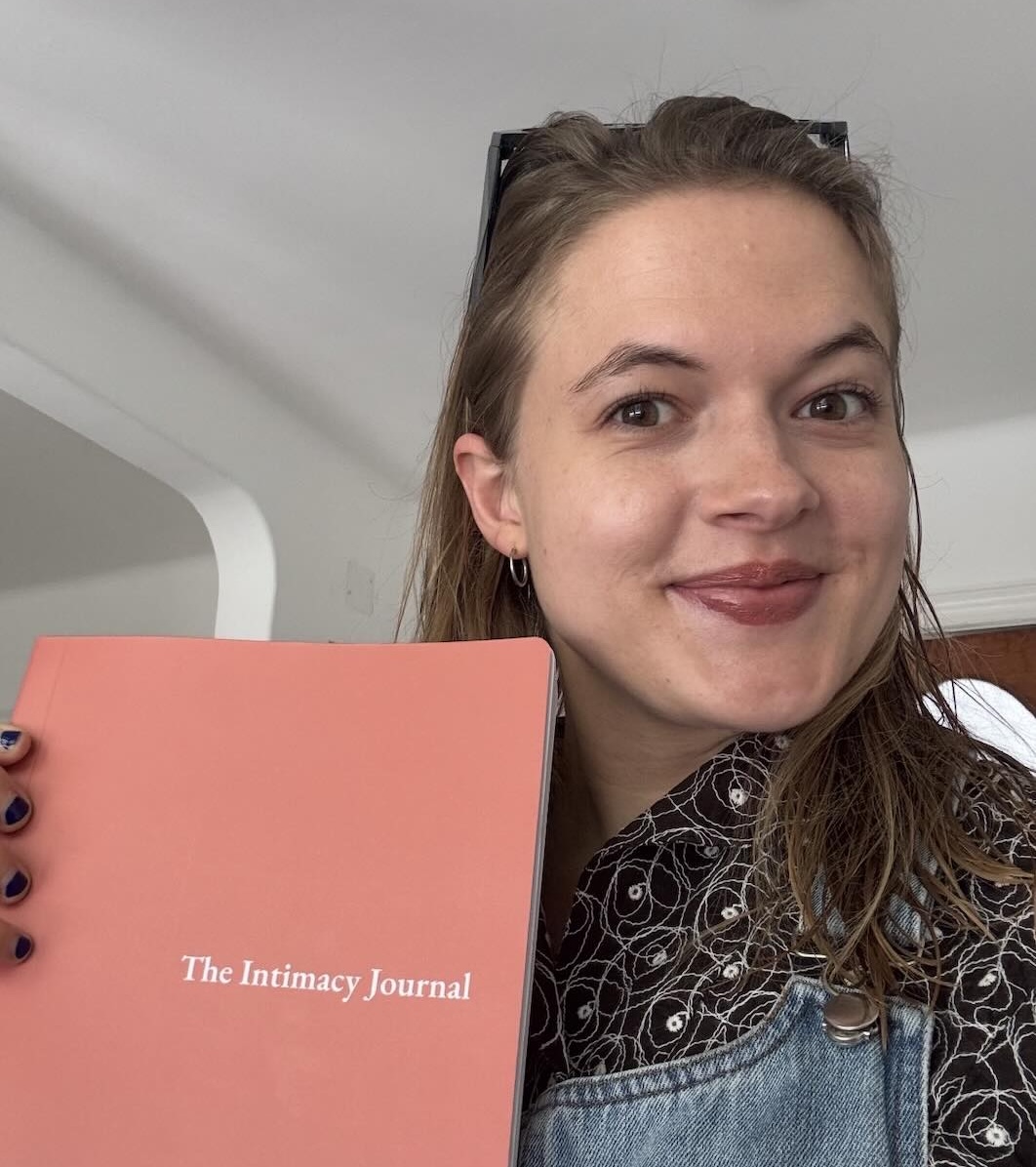
I couldn't find a sex journal I liked, so I created one!
Introduction 🚀
“The challenging thing is that we tend to feel that we live in a liberated age and that, therefore, it’s especially odd to feel that sex is a bit odd.” — Alain de Botton, Design Matters Podcast.
I started exploring these tools by accident while blogging about my love life on my Substack, Misseducated, a couple of years ago. I have always been interested in women’s and sexual health, and in the past, I had felt shame surrounding these topics, like everyone else. Still, I must have been a bit more shameless than most people, because I started writing stories about sex parties I went to in New York and about masturbation experiments I conducted, such as “What is it like to orgasm on psilocybin?”
But writing these articles had an unexpected, life-changing benefit: it helped me define great sex on my own terms, and figure out what I like in bed. I later went on to publish the first guided erotic poetry journal for women, The Intimacy Journal, a paperback sex diary of sorts that you won’t find on Amazon or the best-seller list because I’m a stalwart independent author!
I’ve learned that keeping a sex journal is a highly underrated way for us to explore our more deviant natures, improve our mental health by reducing shame, and understand our sexual selves. Through this personal and private act, you’ll get to set aside the noise on social media and discover who you truly are. You can safely identify your boundaries in sexual encounters, and what sexual wellness and wellbeing look like to you. You can pinpoint the exact techniques that help you orgasm, even, or at least how you like to receive sexual pleasure. While you might not be willing to post your innermost desires on the internet as I do, this methodology will enable you to reach the same ends without anyone else knowing.
So, let’s get started!
The Basics of Keeping a Sex Journal 📓
1. Get yourself an Intimacy Journal! 💁♀️
It can be cute and fuzzy or unassuming and subtle. But yes. You’re going to get a new journal where you write down all your deepest, darkest, and sexiest secrets. Maybe you’re an Accountant, so your sex journal is just going to look like any other bland office book. That’s kind of exciting, isn’t it? Find one that you can hide easily and get to it.
Whichever journal you choose, I want you to sit down in a private place where you can be completely honest with yourself about whatever comes up for you. Stash it where no one else can find it. Unless it’s part of your kink for your partner to discover it, in which case, go ahead.
One of my friends in her late 40s is going on dates again. She told me she recently got a sex journal, and she’s been loving it so far. It’s helping her determine what she likes and doesn’t like about her dates. If you’re curious about where my sex journal is, you can read it. And if you're ready to explore intimacy through writing as well, check out my book, The Intimacy Journal!
2. Confess. It’s good for you 🦾.
There’s some shocking research that keeping secrets is incredibly bad for you. As researchers explore in the book on expressive writing, “Opening Up By Writing It Down,”
“Like other stresses, keeping secrets from those close to us can affect our health, including our immune function, the action of our heart and vascular systems, and even the biochemical work of our brain and nervous system…[it] can place us at risk for both major and minor diseases…Where harboring secrets is potentially harmful, confronting our personal thoughts and feelings can have remarkable short and long-term health benefits.”
So, the first thing you can do when writing in your sex journal is focus on confessing whatever is on your mind and heart, but not quite on your tongue.
3. Prepare the Write Environment (pun intended!) ✍️
The original study that discovered the benefits of expressive writing involved people writing for 15 minutes each day for four days (Pennebaker and Smyth):
- Find a quiet time and place. I write in the mornings, but they recommend writing at the end of your workday when things are calm, and you won’t be disturbed.
- Think of a topic that you have not previously discussed or disclosed with others; perhaps you have even inhibited talking or thinking about it.
- Write about this topic for 20 minutes.
- Don't worry about grammar, spelling, style, or sentence structure.
- Explore how the experience made you feel. Also, how did you feel after writing about it?
- Review your writing: do you notice any patterns or insights to be gained?
The researchers note you might feel sad if you write about an upsetting topic (more on trauma later), but just like watching a sad movie, these feelings will subside. Despite this, they found significant long-term mental and physical health benefits from divulging secrets, in this case, through personal and private expressive writing.
4. Add the Misseducated Method 💌 ✍️
Building off the researchers’ recommendations, I want you to focus on writing about one specific sexual memory at a time. If you’re not having the best sex in your life right now, don’t worry. It’s more impactful to write about things in your past anyway, as it helps you come to terms with previous experiences.
Go back in time as far as you want to. Write about your first time or your previous partner who made you feel the most alive. Write about the person who was the worst in bed. Whatever comes up for you. Or start with a prompt like “Losing My Virginity,” “My First Kiss,” or “The Best Sex I Ever Had,” and go from there. These might jog your memory, to help you keep a sex tracker, if you will:
- Where were you? What year was it? What time of day?
- Harness the senses: What did you see, hear, touch, taste, or smell?
- What did you like about this experience? What did you not like?
- How did you find this person (or discover this toy), and what attracted you to them or it? Notice that you can write about solo play as well.
- What did you learn that you could apply to future romantic interactions?
- Did you try something for the first time? How did you feel about it? Would you like to experience that again or explore something similar?
- What did you feel? In your body, together with your partner, or emotionally at the time?
- How is this experience related to who you would like to become, who you've been in the past, or who you are now? (Pennebaker and Smyth).
The researchers share: “Whatever your topic, it is critical to explore both the objective experience (i.e., what happened) and your feelings about it. Really let it go and write about your very deepest emotions. What do you feel about it, and why do you feel that way? How does it influence your life? Your relationships? Your goals and dreams?” (Pennebaker and Smyth).
5. Explore everything around the sex, also 🗺️
It’s the journey, not the destination, that counts. As you’re writing, be playful about exploring the context of your sexual behavior. Maybe you were sexting your partner when they were in an important meeting at work! (Guilty) Maybe you had a sex toy collection together and a secret name for each of them (Guilty, again).
Notice and identify the random details that attracted you to your partner or that turned you off. There might have been constraints or opportunities in that place at that time, like being apart for a summer, building anticipation. Whatever it is, try to remember the context surrounding your sexual experience and see if that impacted the sex when you finally had it.
6. Psychoanalyze your childhood 🐣
“Our desires, and we can thank Freud for this, of course, emerge from childhood and are reflections of all sorts of commitments and ideas.” –Alain de Botton.
As you identify your desires, fetishes, and kinks, take a moment to reflect on where they might have come from. For example, one thing that I like is having my partner count down from 10, giving me a time pressure by the second during which I have to reach orgasm. It’s embarrassing to admit this, but if I perform well, I then want them to call me a good girl. I have a textbook praise kink.
Where could this fetish have come from? It may have something to do with growing up in a very academically rigorous environment, where I constantly had to perform well on timed exams. And perform well I did! It sounds fucked up, but Alain de Botton luckily has an explanation for this. He said,
“We grow up having to be good boys and girls…and one of the things I think we want from sex is a release from that pressure…We want to be seen as good, but not having to be good in any kind of overly punitive way. So, being bad yet accepted is a really strong sexual fantasy. But again, it’s not just a sexual fantasy. It’s a human fantasy. How we want someone else to treat us.”
The desires we discover through sex journaling might sound embarrassing at first. But once we reflect on it, their origins can be quite logical.
We can also have a fetish for an inanimate object. Alain de Botton gives the example of a friend who gets turned on by men who wear old, expensive watches. She doesn’t have daddy issues; “it’s the qualities she associates with her father that are embodied in that watch. And the watch becomes a sexual object.” In this sense, our sexual desires are a symbol of how we want the world to be. She might have wanted the world to be a place with more gentle, older men, which the watch symbolizes, he explains.
7. Accept your current world, inverted 🙃
I am a very independent person. As the Pacha Mama girls would say, I am “living in my masculine” because I make all my own money, take myself on trips, and navigate this world as I god damn well please. However, when I’m intimate with a partner, and I feel safe, I tend to prefer the opposite. I’m a sub who likes to give up control and be at my partner’s mercy. Maybe I even like to be mistreated by them sometimes. Shocking, isn’t it? Can I even call myself a feminist?!
If writing in your sex journal leads you to uncover a desire that goes against your values and social status, be gentle with yourself. This is normal and natural because societal pressures come at us from all angles, and we need to let off steam somewhere. If you get scared by a sexual desire that you uncover, remember that it’s okay. The goal is to learn more about your erotic desires and feel more acceptance and love towards them, rather than judging yourself. They are a part of who you are, too.
8. Highlight your desires that challenge societal norms 🍩
Growing up, socialized as a woman, I was constantly bombarded by images of men with six-packs fondling models on beaches. From this, I learned what I should find attractive in men. But while journaling about my sexual experiences, I realized that I had had lots of sex with men who were shorter than me, men who had very small penises, and obese men. And you know what? None of it fucking mattered. Why? Because I liked their intellect and conversations, or they would buy me my favorite pastry and cook me dinner, or they would eat me out whenever I wanted.
Journaling about your sexperiences helps you understand what actually matters to your unique sexuality and see how it might differ from the superficial societal six-pack bullshit. If things matter to you beyond their looks, maybe things other than your weight or your hairy legs matter to your sexual partners, also. You might remember that a partner you felt very comfortable with also liked it when you had a bit of a tummy or whatever it was. Highlight those findings and celebrate them.
9. Tap into your body and your menstrual cycle 🩸
Your menstrual cycle might not always be relevant when you’re remembering your sexual experiences, but how you felt in your body and your mood definitely are. Sex is going to feel different if it’s with some hot Parisian waiter you just met and you’re ovulating versus when your grumpy boyfriend of three years is nagging you for a blowjob, and it’s the first day of your period. Or maybe you’re going through menopause and experiencing vaginal dryness. You’re not alone!
In addition to writing about my sex life, I use the Clue app to track my moods throughout the month. It helps me remember that if I had the ick and was angry at my boyfriend that one night, my hormones might have been interfering, depending on the time in my cycle. When you’re journaling, try to bring awareness to what you were physically feeling in your body at the time.
10. Keep writing. Keep experimenting 📓 🧪
With time, keep dipping into your past and adding to your sex journal. Of course, not all techniques will work for everybody. Ultimately, “you should be your own researcher. Experiment with different topics and approaches. Something may work for you in resolving your own conflict that may not work for anyone else.” (Pennebaker and Smyth).
What about traumatic memories? 🫣
Good question. I am not a psychologist, but I am a trauma survivor. According to the research, “having nearly any kind of traumatic experience is bad for your health. However, if you keep the trauma secret, it increases the odds that you will have health problems.” (Pennebaker and Smyth).
It’s been shown that writing about trauma has significant mental and even physical health benefits. Traumatized participants who wrote about the most difficult experiences in a similar format, 15 minutes per day for 4 days, subsequently visited the doctor less and had fewer illnesses. Plus, they gained a greater sense of value and meaning in their lives in the long run.
Whether now is the right time to write about your traumatic memories depends on how you feel about your situation. The researchers share,
“If immediately after a terrible experience you feel you need to write, then write. But if you feel you aren't ready, don't. If you start writing and feel you aren't making progress or you're getting more distressed, stop. Write about less emotional topics. Write about superficial issues.” (Pennebaker and Smyth).
This reflects my experience. After the most extreme sexual assault of my life, I suffered from severe PTSD for about 6 months. I didn’t feel comfortable writing about it at first, but about a year later, I put pen to paper. Eventually, I wrote a 10k-word trilogy of articles, starting with my story. I found writing and sharing my story in podcast form also very therapeutic. As someone who loves writing, I didn’t know at the time that a sex therapist or healthcare professional might have recommended this alongside my therapy. I just wrote,
“Going through a traumatic experience is like being handed a giant, dark, disgusting plate. But I’ve found that every time I tell my story, another shard of it is broken off. Sharing the burden of my experience with other people has helped me a lot. Because this pain, at the end of the day, isn’t ours. We were just in the wrong place at the wrong time. Your trauma is not yours. It belongs to the human condition, and it is not yours to bear fully.”
Conclusion 🕊️
“It’s the ongoing liberation of the human spirit as we tackle evermore subjects that have previously lain in the darkness…There’s a general realization that things which were very much seen as being on the margins of human desire actually may lie quite close to a kind of norm.” — Alain de Botton.
I hope this article inspired you to keep a sex journal. It was a true joy for me to write this for you. Yet, much like giving ourselves permission to explore our sexualities, I think writing this for you has helped to heal something inside of myself. It’s a tool I wish I had at least a decade ago. Better late than never!
Let me know how your sex journaling goes, if you want to! No pressure.
Love,
Tash
💌 ✍️
Take the next step: order your copy of The Intimacy Journal now and start exploring your desire on your own terms!

.svg)

