
Introduction
After four years living in Mexico City, I can spot someone in the Tuluminati a mile away. Or should I say, I can “feel their energy” at first glance, even though I am spiritual-lite. Here I aim to clarify the distinct phenomena of their subculture so you can spot them for yourself, or even better, look at yourself in the mirror and assess your Tuluminati-ness on a scale from 1 to 10.
The History of The Tuluminati
Once upon a time, there was a festival called Burning Man. It began with a bunch of hippies in the 1980s, but like many beautiful things in California, it was soon completely transmuted by an influx of tech money. The crypto and tech bros had funds, and they wanted to have fun!
Then, in March 2020, a crisis struck. As a global pandemic raged, these tech-minded Americans and Europeans were suddenly forced to stay indoors and wear masks. The offices were closed, and people got bored, especially in cities like San Francisco, LA, and NYC, which had the most restrictions. Governments were telling people what to do! So, the tech people did what anyone with enough power and resources would do to surpass the vaccine and mask mandates: they went traveling.
Mexico had its own pandemic rules that were more relaxed than those in other countries. The tech people congregated in the tiny beach town of Tulum, peaking in 2021 and 2022, once word spread. There, they could practice their Burning Man-based rituals without their disdainful, mask-wearing American peers dragging them down, and build their own luxury hotels and communities like Aldea Zama and Ahau. They moved their businesses online and quickly became extremely comfortable with the fact that their dollars, pounds, and euros went a lot further there.
By 2022, many famous and wealthy people were bobbing around Tulum, including musicians like Diplo and Steve Aoki. There were massive beach parties. And all was well. Until US companies started mandating a return to the office. Why do that? Why not just keep the fun going…forever?
So, the Tuluminati were born. This group represents a modern subset of global nomads whose lifestyle blurs lines between spirituality and privilege, creating communities in Mexico and Bali despite language barriers or lack of permanent roots. Their ongoing travels, driven by tech and crypto wealth, symbolize the intersection of countercultural practices and gentrification. Despite concerns about sustainability and integration, the Tuluminati lifestyle continues as long as economic means allow. #tulumisdead, or is it?
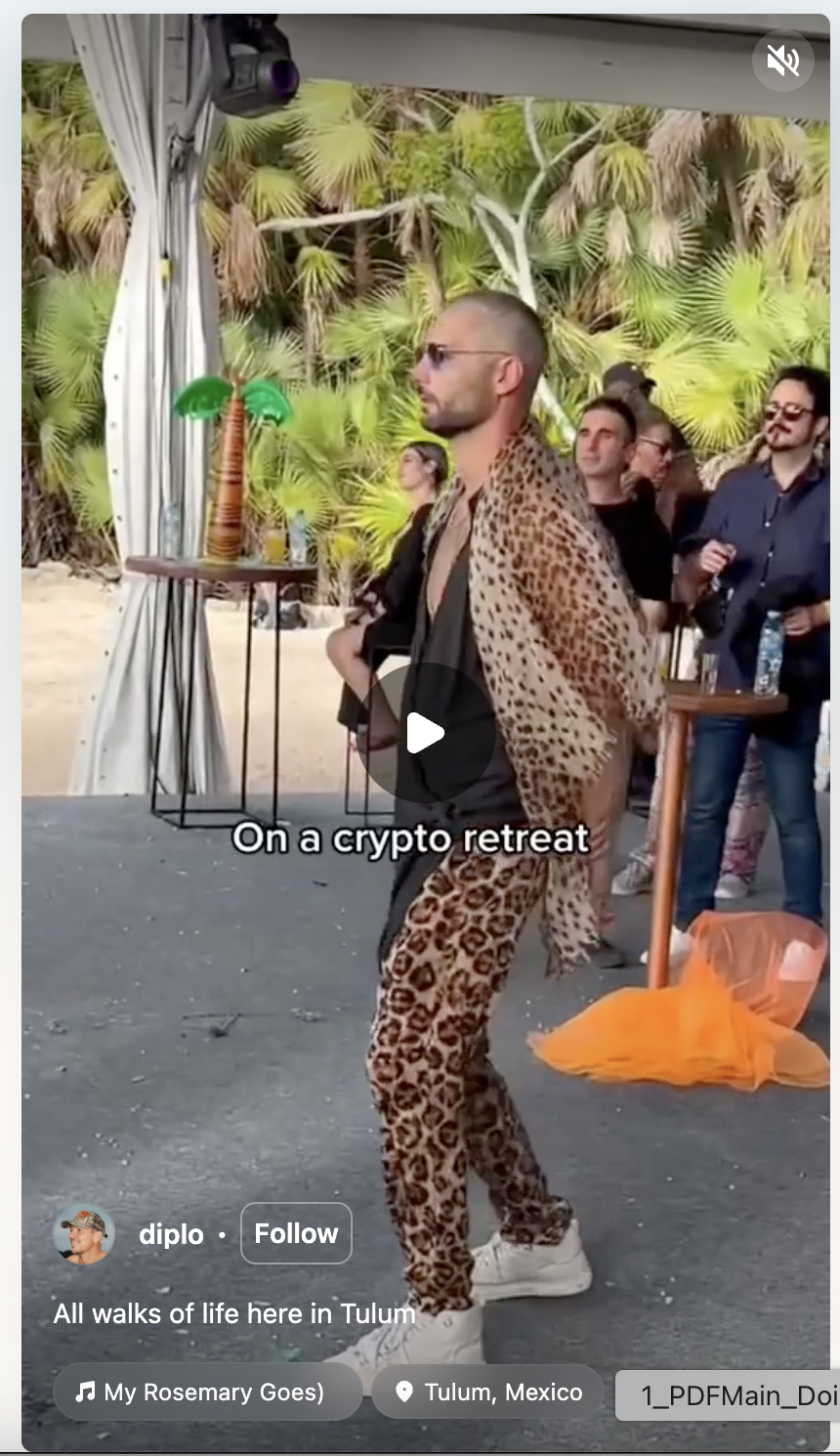
What do the Tuluminati wear?
The clothing of the Tuluminati is very distinct, especially standing out in Mexico City. It is usually “spiritual” in nature, which can mean Mexican linens and capes, or kaftans and religious-looking hats. A wide-brimmed sombrero-style hat is a dead giveaway. Men may also be drawn to wearing a linen shirt without a collar, a style more typically found in places like India. Tuluminati of all genders often wear large pieces of jewelry. The goal of their garb is to make a statement about who they are to the world: different from the norm, spiritually distinguished, and commanding reverence and respect.
While many Tuluminati claim to embrace relationship anarchy, in my experience, older men dominate the community, especially those who wear pseudo-spiritual garb. Beards and tattoos are as desirable as large bank accounts. Tuluminati men are allowed to look older. For example, I recently met a very kind Tuluminati man, and I immediately perceived him to be wiser than he actually was because he was wearing a long, white linen robe, a kind of embroidered, circular cap that was flat on top, and many leather wraps on his wrists, as well as beaded necklaces.
Tuluminati women tend to be very thin and often vegan. They also wear cloak-like, boho, baggy linen clothing, but opt for extremely revealing, sexual clothing. For example, I recently attended a Tuluminati party and saw a girl wearing a thong-style leotard, wrapped in a few thin black ropes. As a bisexual woman, I couldn’t take my eyes off of her. Tuluminati women avoid bras whenever possible, but they still often shave their armpit hair to complement them. Again, the Tuluminati are not hippies. Women are “in their beauty” and embracing their divine feminine energy. They perform their femininity within the confines of the male gaze, so to be anything except divine, beautiful, young, and desirable is a big no-no. They may also wear cowboy hats and sparkly, minimal Burning Man outfits. Form-fitting. Flattering.
Overall, the spirituality of Tuluminati clothes is both obvious and ambiguous. You notice their symbols, amulets, and tokens, but it’s not clear what they mean. If you ask them about a particular symbol, they’re likely to tell you a long-winded story about some far-flung place in the world they got it from, that will make you feel spiritually inferior.
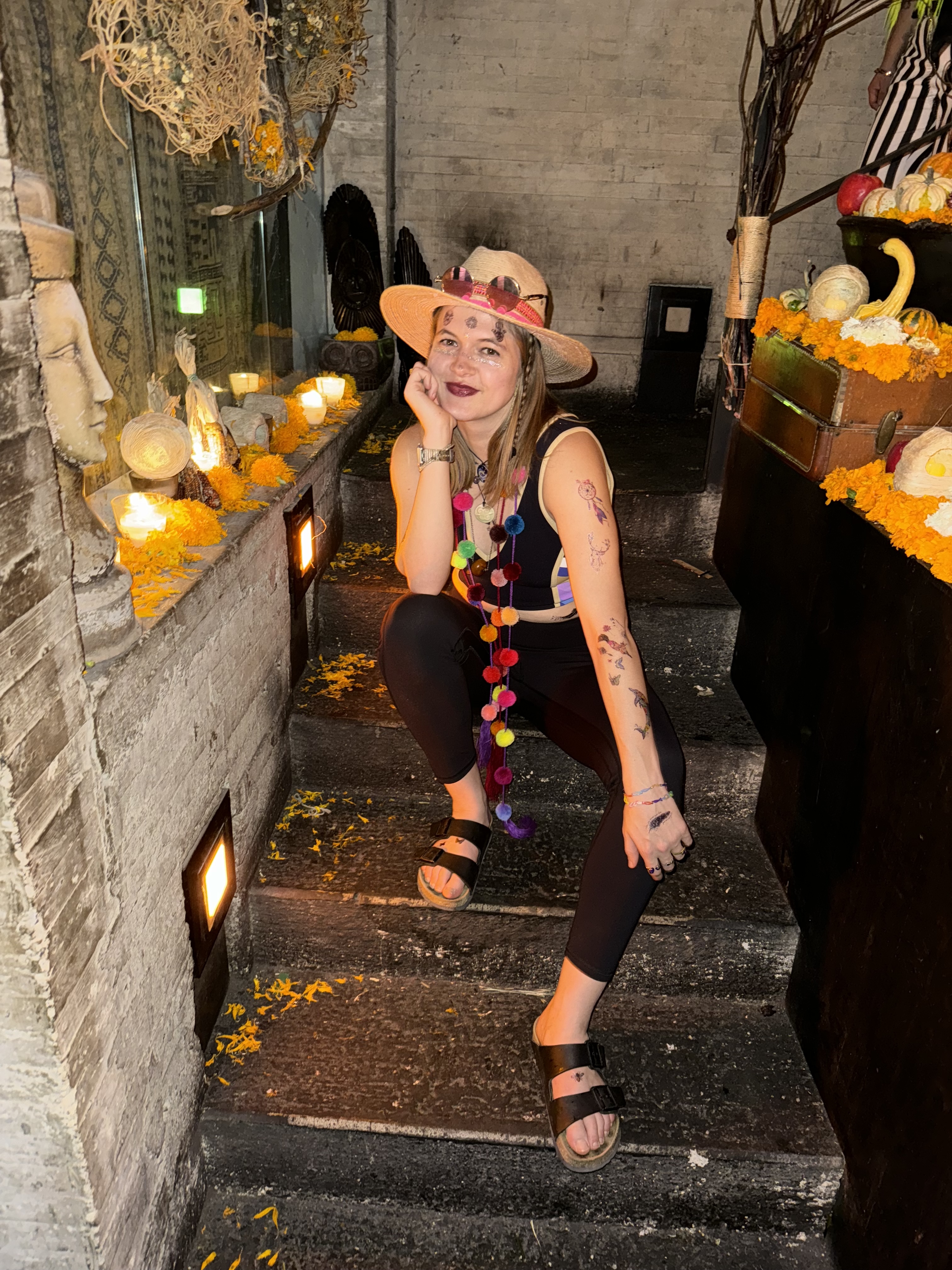
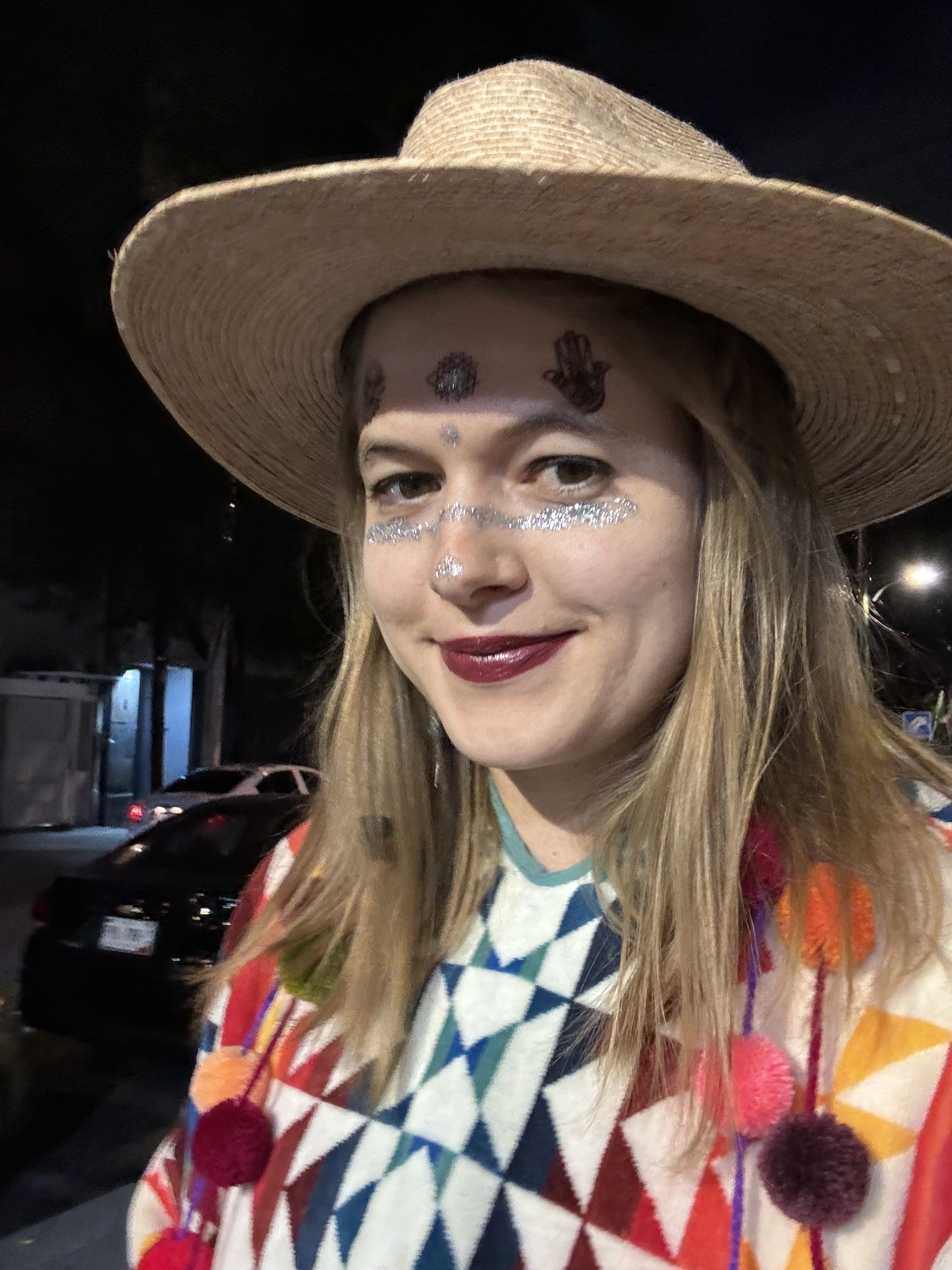
I dressed up as the Tuluminati last year for Halloween. Notice my appropriation of colorful pom-pom strings from Puebla, my wide-brimmed hat, my "spiritual" tattoos on my arms, sparkly face tattoos, and the incongruous mix of brands, including a Free People tank top, Lululemon leggings, and Birkenstocks. Plus, reflective sunglasses inside, of course!
What is the Tuluminati lifestyle?
Nomadism is central to the Tuluminati lifestyle, yet this creates contradictions: they don’t have furniture or a stable home, yet they travel in groups and love festivals, ever-prioritizing “community.” They might care about nature and the environment, yet still accept an offer to fly private to a festival in the Brazilian jungle to perform their water, breathwork, or kundalini yoga ceremonies. They fluctuate between major cities like Miami and New York, and remote cenotes and jungles in Mexico, where they can have “truly authentic experiences”.
Much like the rest of the nomadic tech elite, the Tuluminati are always optimizing their lifestyle for richer experiences. They have to be in Miami for Art Basel for one week, then at an ashram in India for shamanic training the next week. Two days in Mexico City to play a gig and say hi to friends before they schlep themselves off to Iceland for a rave and DJ set, before a special DMT retreat in Ibiza and truffle foraging ceremony in Italy. Sleep deprivation and the performance of being a social, extroverted person go hand in hand.
The use of drugs and partying until sunrise is prolific amongst the Tuluminati. They are predominantly a nocturnal culture. They sleep when they can during the day, given their flexible remote work schedules and non-traditional sources of income. Not to mention crypto! This varies. They may encourage you to do a bump of ketamine at parties to absorb the music and be fully present. Alternatively, it can be plant medicine ceremonies led by Maya leaders in a forest.
Part of their spiritual excursions involves sitting with indigenous shamans and taking psychotropic substances like magic mushrooms, ayahuasca, and peyote. But they are likely to interpret these traditional medicines to serve their own cult-like, partying agenda. For example, I recently attended an event where everyone was required to wear black. Hundreds of people sat on carpets and meditation cushions, and were led through a guided psychedelic mushroom ceremony and vibes before a band of spiritual music in Spanish played for hours. Electronic music followed, and the event continued until whenever.
How are relationships and gender roles in the Tuluminati?
Their interactions echo both their ideals and contradictions. Despite their attempts to transcend “traditional” sedentary cultures, the Tuluminati have pretty defined gender roles. This is a performative culture centered on seeing and being seen. They stand out wherever they go, and are only surrounded by people who look and think exactly like them at the holy grail, Burning Man.
The women of the Tuluminati are usually conventionally very beautiful. They are often thin, with blonde hair, and frequently have spiritual tattoos, such as stars, constellations, and animals. Their jobs are mostly related to their beauty, divine femininity, and, of course, their rejection of traditional “Western” medicine. These include somatic coaching, crystal healing, health products, water, and chakra-aligning ceremonies, and, most importantly, yoga. They tend to be extremely sex positive and can also be prone to spiritual narcissism. Are they goddesses, or just slightly-less-basic lifestyle influencers? We’ll never know.
On the other hand, the Tuluminati man is both lost and found at the same time. He will try to reject or transcend traditional “tech” culture by instead…traveling around the world while fundraising for his new AI-powered in-person community app. The Tuluminati man is an avid salesman, selling investors on himself just as much as his app, preaching in his long robes, complete with leather necklaces, beads, and sunglasses, indoors. Tuluminati men struggle to break away from capitalism, but through tech and crypto, they remain part of it, because the Tuluminati man must be wealthy enough to afford the traveling lifestyle and, ideally, support a female partner.
When it comes to male-female interactions, the Tuluminati culture is one of “soul-connections.” Cynically, this is a front for ensuring there’s enough wealth between them to optimize their experiences and lifestyle. Many times, you will see a man with a salt-and-pepper beard, well into his 40s, 50s, or early 60s, and a thin, beautiful girl trailing alongside him. This dynamic is ultimately about power and sex.
There are gay, lesbian, bisexual, and trans people in the Tuluminati. Public displays of affection are accepted, and Tuluminati people can be more open about their bisexuality, whether they’re a cis man or cis woman. However, bisexuality can also be performed amongst straight Tuluminati women who make out to fulfill the fantasies of straight men watching. Even in a culture that is ostensibly about anarchy and rejecting conformity, cis Tuluminati women still fall into the trap of performing for the male gaze.
The Language, Spirituality & Shamanism
While English is the common language among many Tuluminati, they often enjoy spiritual music with Spanish lyrics. Words like “corazon” (heart) and “alma” (soul), etc., don’t sound quite as romantic in English as they do in Spanish. Ecstatic dance is big, as are electronic DJ sets from Burning Man or folktronica slow beats. Dancing is a perfect way for a Tuluminati woman to express her divine femininity and perform her sexuality in front of keen males.
Unlike the tech bros in San Francisco who believe they personally can save the world, the Tuluminati prefer to hijack indigenous practices with their own narcissism and shamanic leadership. They’re more likely to explain a 4-day silent Sun Dance experience they witnessed, led by indigenous people in Bacalar, Mexico, and how difficult it was to access, rather than claim a personal messiah complex outright.
With the Tuluminati, there is a lot of talk, tarot, and astrology. There’s shadow work, the divine feminine, the dark masculine. Dominance and submission in a sexual sense. There is also a lot of talk of energies, of sensing the energy of a person when you first meet them, of premonitions, manifestations, and signs coming at you from the universe in all directions. It’s raining? That’s a sign from the great spirit of financial abundance, and she wants you to take on those three new clients for your “limited edition” water ceremonies, but charge them $1,000 per hour this time. It’s about messaging, the world, and the great spirit, the mother, who is speaking to you now and always.
What are their backgrounds?
Given their lavish lifestyle, it’s clear that many Tuluminati came from privileged backgrounds. After a boring, middle-class upbringing, they may have experienced serious trauma, like losing a parent or getting fired, to discover their need to reject a culture where they never fit in. They are often trust fund babies and recipients of all-paid bachelor's degrees. I imagine that many of the Tuluminati’s parents are lawyers living in the Washington, DC, or Chicago metro area, or accountants in Zurich. Yet their offspring travel to these more sacred, “spiritual” lands to heal their trauma. The most performative among them may change their name to something like “Colibrí” or “Mother Wind” to convey their new, “true” identity.
Many of them are from the United States, aligned with their proximity to tech industry money, crypto, and power. Additionally, they come from the UK, Canada, Russia, Germany, and Sweden. It depends. There are also a few Mexicans, but, of course, most of the Mexican Tuluminati are in Bali, which is a more alternative option for them than Tulum.
Tuluminati differ from typical hippie subcultures because they are often well-off, educated, and generally upper-middle-class. They are not your typical penniless backpackers. Instead, they secretly attended prep schools, hold fancy degrees, and may even have renounced successful careers in Finance, Law, or Banking before their spiritual transformation. They are not interested in running for political office or becoming an industry titan, but still benefit from being adjacent to traditional power structures. They may dream of denouncing capitalism one day, living off the grid, and buying a plot of land in the Mexican nature somewhere. But in the meantime, they still need money to fund their nomadic lifestyle. Burning Man isn’t cheap! They’re like gentrified hippies in that sense: they embrace the ideals of loving nature, but they need to be able to buy cute outfits to wear to festivals.
Conclusion
While I find the culture of the Tuluminati overly performative, I appreciate that there are people like them out there, living lives in which they seamlessly surpass international barriers and pursue new innovations. I find their performance, male-centric focus on femininity, uncomfortable and intimidating. I don’t feel safe in that environment. However, I also appreciate the idea of treating the world like your oyster and building projects all over the globe. I appreciate their unique blend of access to capital, creativity, and alternative cultures. They do build rest through shamanic experiences into their process, when they’re not out doing a bunch of ketamine at a party. Ultimately, I admire them for living the lifestyle they want. It’s also probably quite fun to belong to a global community that constantly inspires you and encourages you to go deeper, even if it’s purely to perform spirituality for others.
So, what do you think of the Tuluminati? Are you part of them? Did I represent this sexy, spiritual sub-culture accurately? Excuse me while I go take a bump of ketamine at this kundalini yoga retreat.

.svg)

