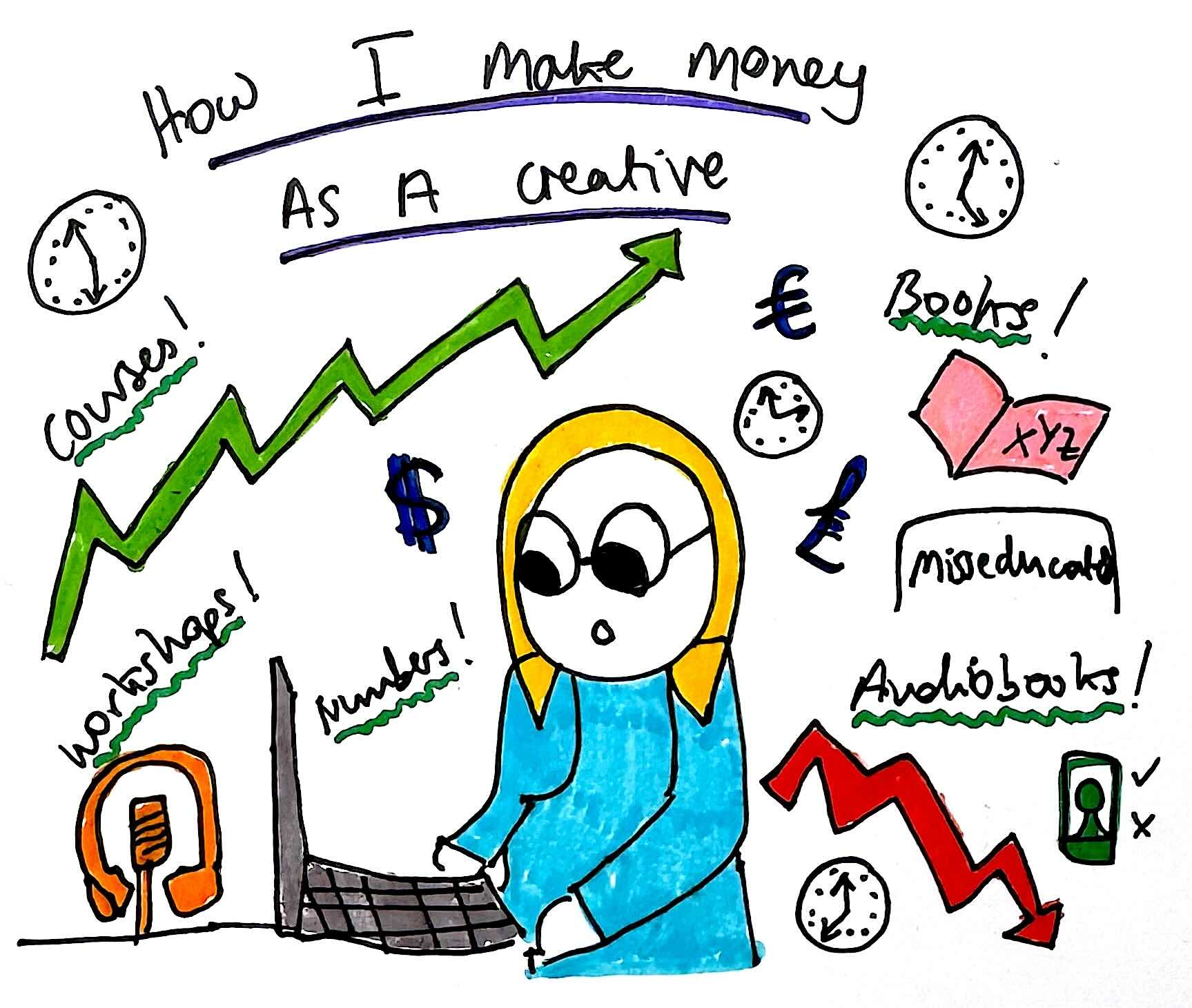
How I Make Money As A Creative

An Illustrated Guide to $15k in Revenue in 4 Years

How I Make Money As A Creative

“I have had to learn the simplest things / last. Which made for difficulties.” — Charles Olson, “Maximus, to himself

Introduction

I’m Tash Doherty, and welcome to the honest financial breakdown of how I made $15k USD from creative income over the last 4 years. Whether you’re a long-time lurker on my blog or a first-time creative trying to figure out your way, I hope my successes and failures shared here help guide you in your next steps building your own career, or help you gain a useful framework or two.

I quit my miserable corporate job in New York in March 2022, and since then, I’ve been building Misseducated, a Substack blog and podcast where I’m on a mission to help the world be shamelessly sexy. I’m up to almost 800 subscribers, and I’ve published two books: These Perfectly Careless Things, a novel, and The Intimacy Journal, a guided erotic poetry journal,  from which I teach intimacy writing workshops. I help people use the power of writing to explore their sexuality. My creative assets have made me this much money so far:
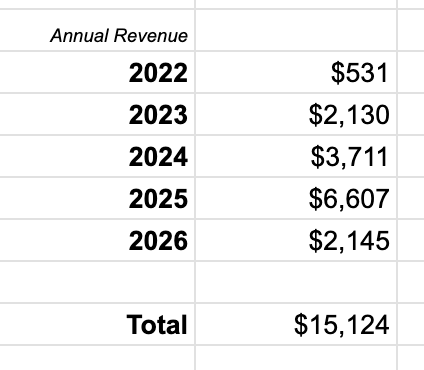
My revenue totals just over $15k USD, and it’s trending in the right direction 📈, but reality is a bitch. I’m in the messy middle of building this new life, and it’s not enough for me to live on in a meaningful way, as the rest of my income comes from consulting projects and my savings. Still, I’ve recently stumbled across some new, bigger-ticket opportunities, which I’ll get into, and I hope to make more money this year than last. But I’m not holding my breath! Here’s that $15k broken down by the products or services I’ve sold:
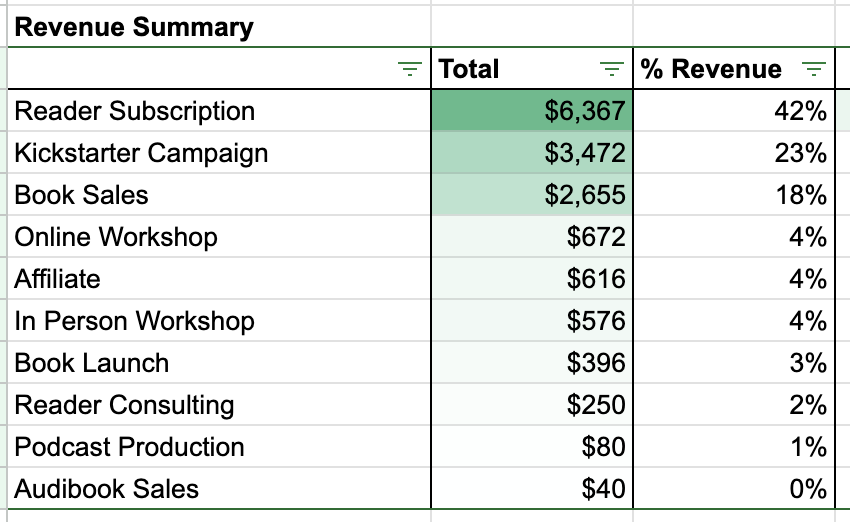
Now, let’s crunch some data and get the full scoop of what’s going on here 😎🤘.

The Deep Dive

Reader Subscriptions (Paid Substack Subscribers) - 42% of Revenue

You might look at the table above and think: that’s amazing! Just blast people on Substack and milk every dollar out of your paid Substack subscribers as possible! Well, not so fast. Those numbers on a yearly basis tell quite a different story.

Or if you prefer to see numbers visualized, here’s my ARR in one big, fat frown, lol ☹️.
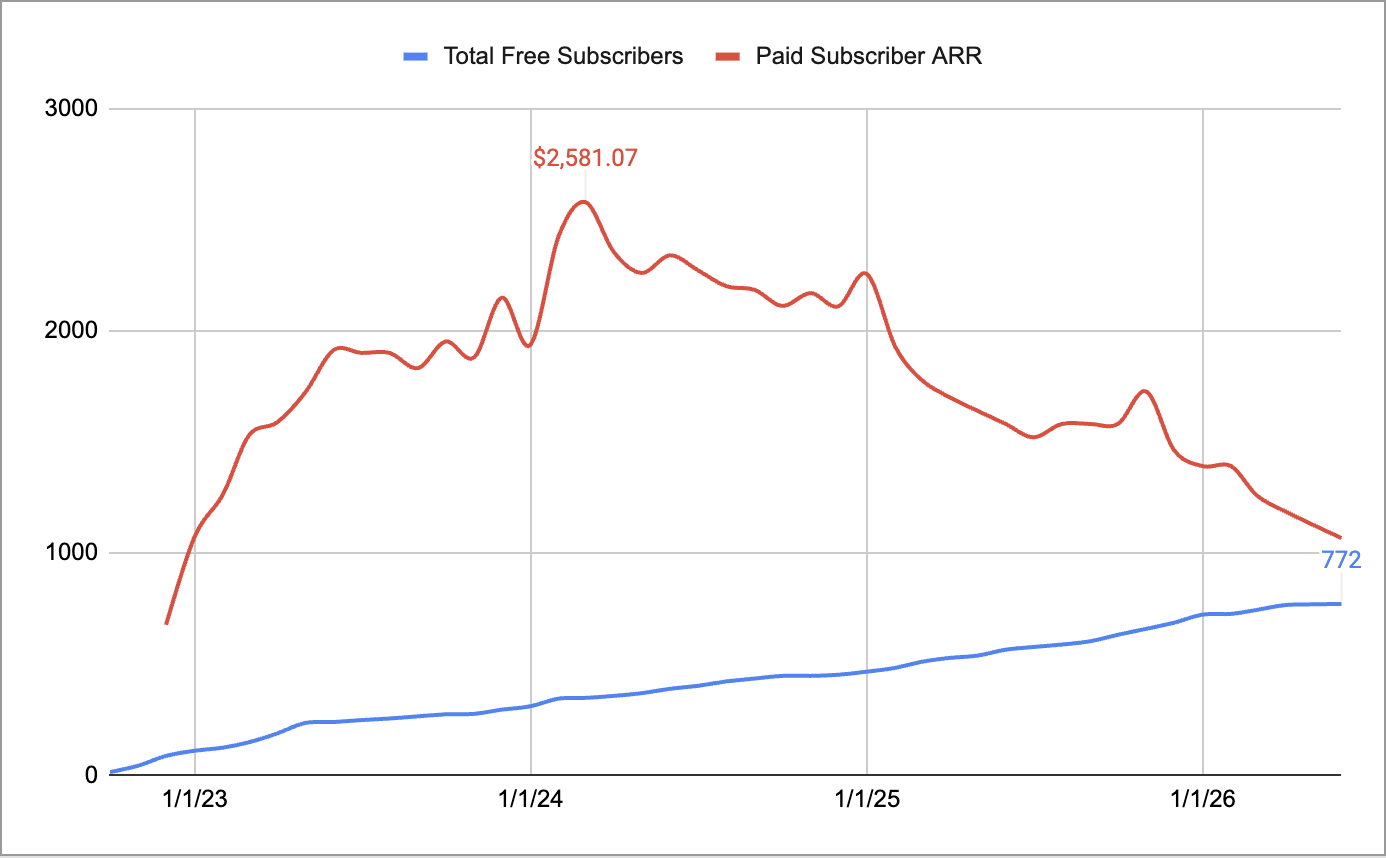
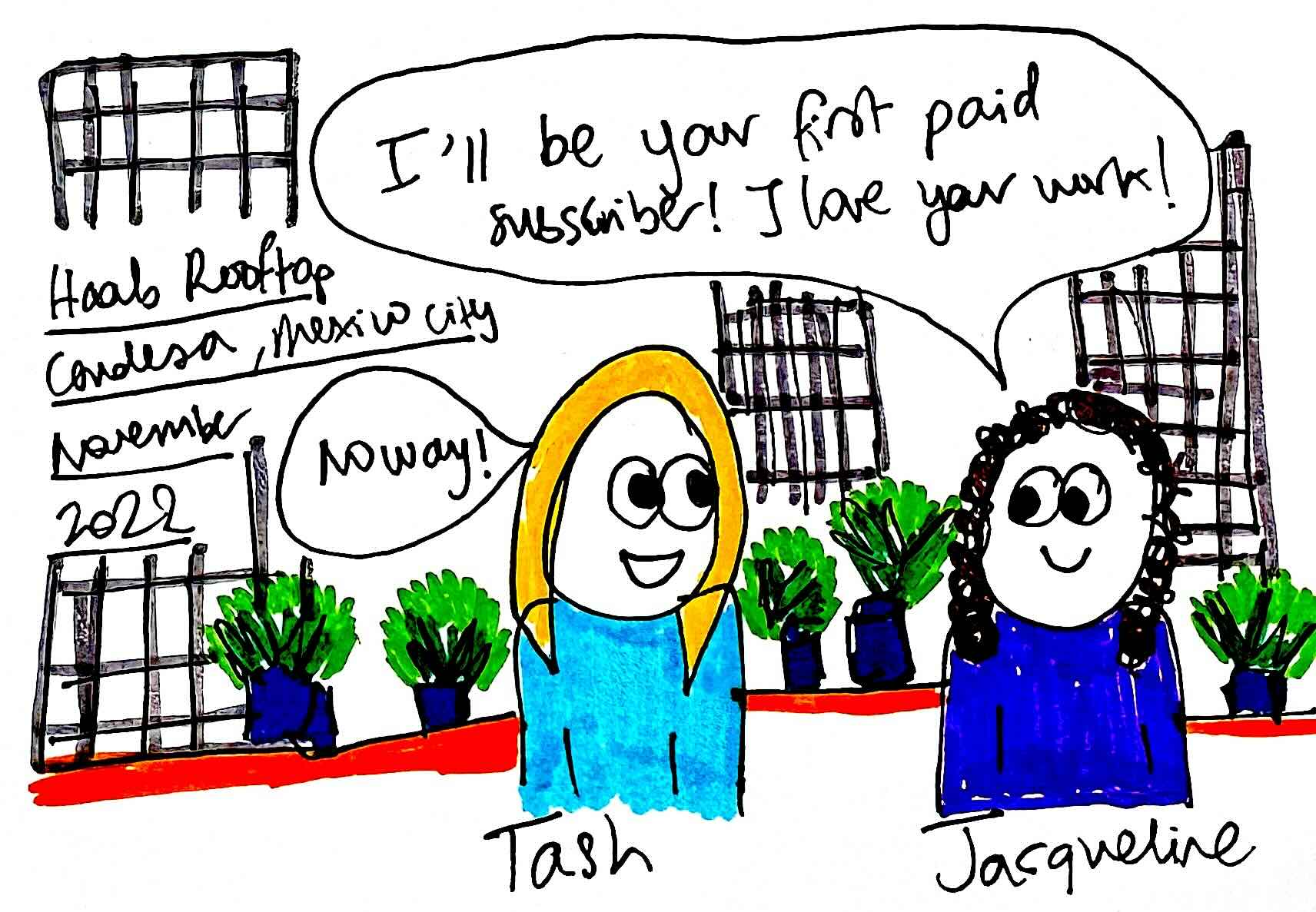
Launching my first paid subscription on my Substack in November 2022 was a huge deal at the time! I remember meeting up with my new friend Jacqueline on the rooftop at Haab in Condesa, Mexico City. She was the first person who agreed to pay for my creative work. Wow!
However, keeping paid subscriptions going has been extremely challenging. It forced me as a writer to produce double the work: regular content for my free subs and special content for my paid subs, every week or every month. Over the years, this has caused me an insane amount of stress. I’ve constantly struggled with whether I’m doing enough for my paid people, and I don’t want them to hate me.

Another tradeoff I didn’t foresee was that I kept my more x-rated content behind the paywall (you know, like the articles where I admit to liking butt stuff), which was really annoying because only the few people who paid could access my best stuff. After years of internal struggle, in November 2025, I just said: fuck it. I’ll ungate all my content, forego the short-term revenue, and just focus on growing my audience as a whole.
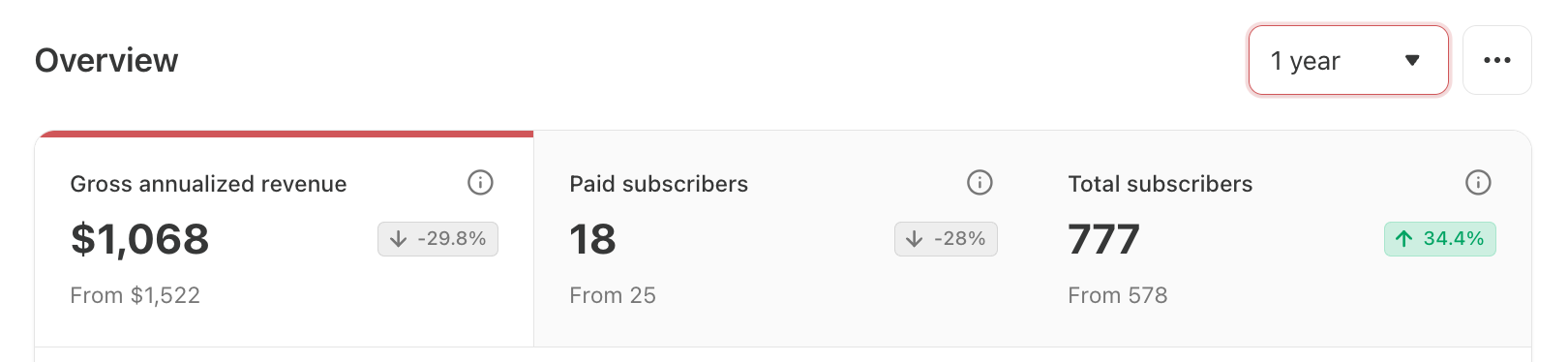
In the short run, this worked. My gross annualized revenue declined by 29.8%, but my total subscriber count has increased by 34%. Now the novelty of that has worn off a bit, and growth has stalled, but that’s okay. I’m a lot less stressed than I used to be, and I’ll survive it.

FYI, if you’re a writer, notice that I still have paid subscriptions turned on. I just explicitly told my subscribers that this is now a “buy-me-a-coffee” model, and while a bunch of people dropped off, those that still pay adds up to just over $1,000 per year. The point is, your family and friends do want to support you, so consider turning on paid subscriptions so they can.

Money Summary: Reader Subscriptions (Paid Substack Subscribers)

Requirements: Writing weekly or monthly paywalled content, in addition to regular content

Revenue Potential: High, but only if you can keep it up

Effort Needed: High, all the fucking time

Creative Satisfaction: Medium

Stress Level: Extremely High

Tash’s notes: Paywalled content is bad for growth in the early stages, but consider turning paid subscriptions on with a “buy-me-a-coffee” model.

Kickstarter Campaign (23% of Revenue) & Book Sales (18% of Revenue)

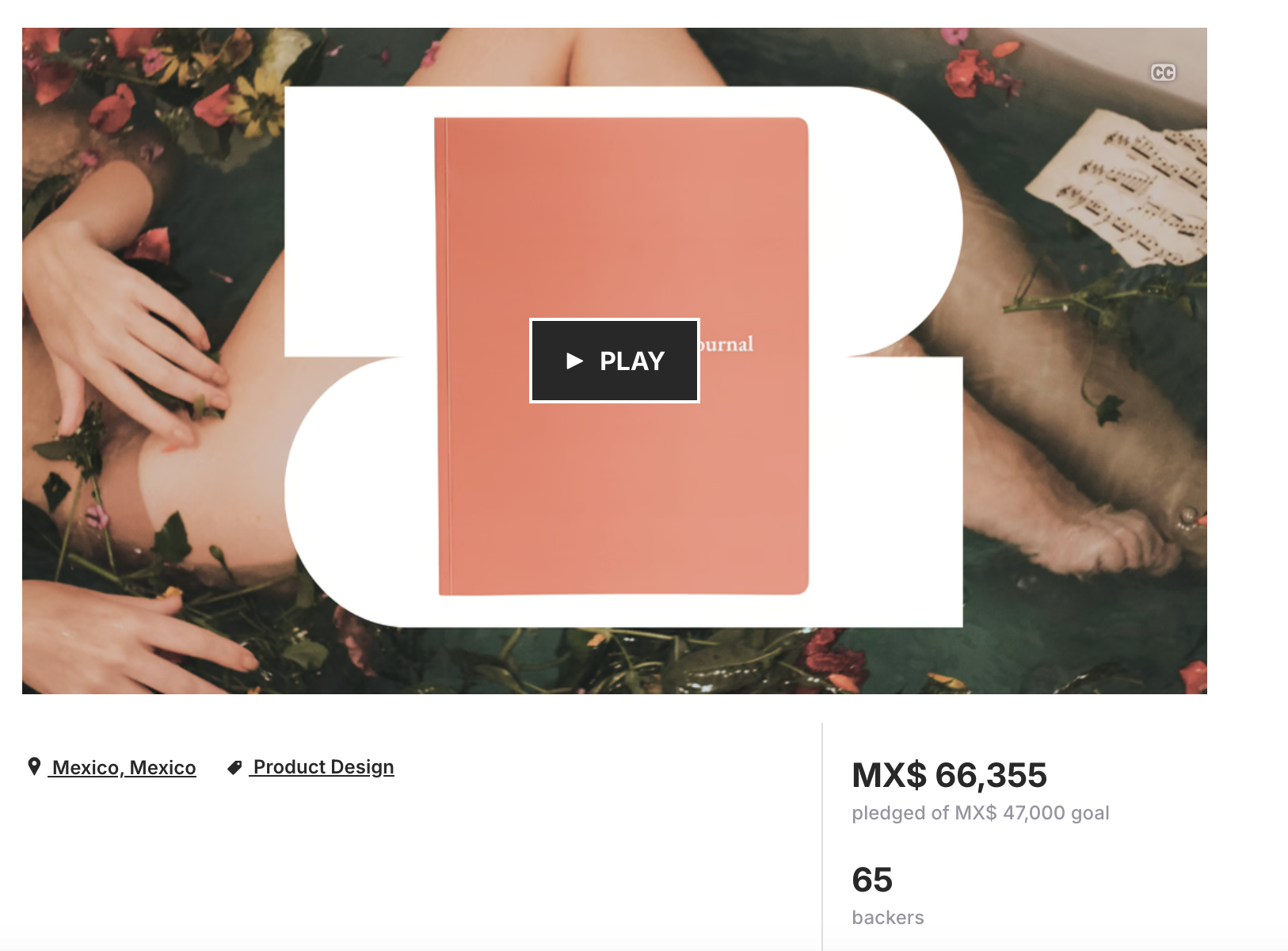
I launched a Kickstarter Campaign for my second book, The Intimacy Journal, at the end of 2025. It did pretty well, and we were fully funded in 12 days. I found setting myself a challenge to complete a creative project in a limited time very effective; I wanted people to be able to buy The Intimacy Journal as a Christmas gift, so I started grinding on July 1st and got it done. Deadlines work, people! Or at least they work for me when there’s a project I want to do.
I’ve made more money from my “Kickstarter Campaign” ($3.5k) than from all my other “Book Sales” combined ($2.7k), which tells you a sad, hard fact about the book business. For all the time I have spent writing my books, the return so far has been extremely poor, but money isn’t everything (see Key Learnings below). Still, I’ve improved significantly between the books, around 4.8x!

I learned a lot from publishing the novel ($10 for digital, $16 for paperback, an automated process but shitty margins on Amazon), and applied it to the journal ($15 for digital, $29 for paperback, gift-quality product only available on my website).

I’ve sold around 200 copies of These Perfectly Careless Things, a novel which I wrote on and off for 15 years, and I’m deep in the red on my novel when you add in the $1,000 I spent on the copy editor only (not including the book identification numbers (ISBNs), the hours, the developmental editor, the software for formatting my book, the print-on-demand orders).

Meanwhile, I’ve sold 250 copies of The Intimacy Journal, which took me 4 months end-to-end to publish, so about 2% (1/45th) of the time my novel took. Plus, The Intimacy Journal comes with additional revenue streams: this $6k figure also includes hosting intimacy writing workshops, 1:1 creative sessions, and the extra copies I’ve sold. It’s crazy to see the line differences over time:
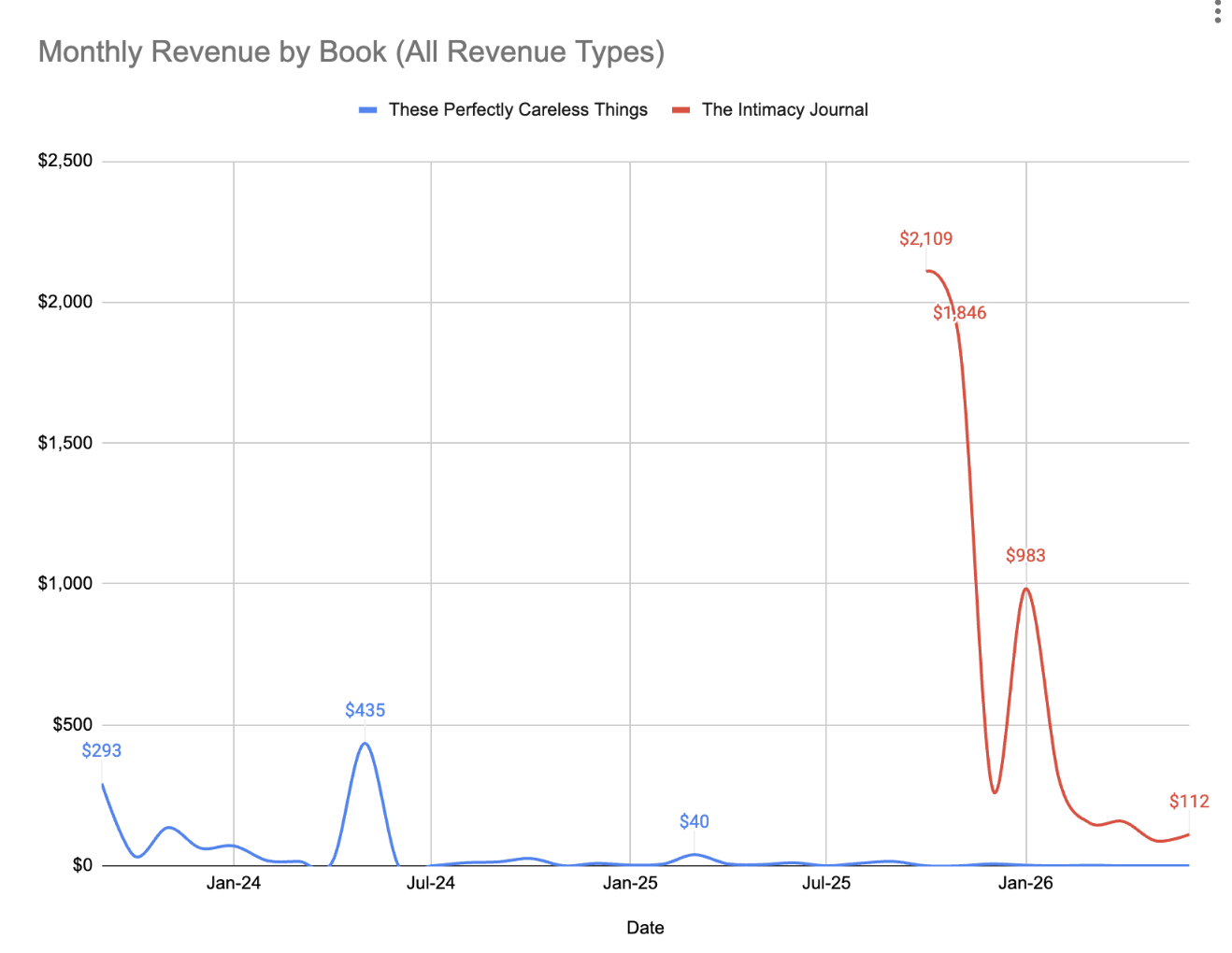
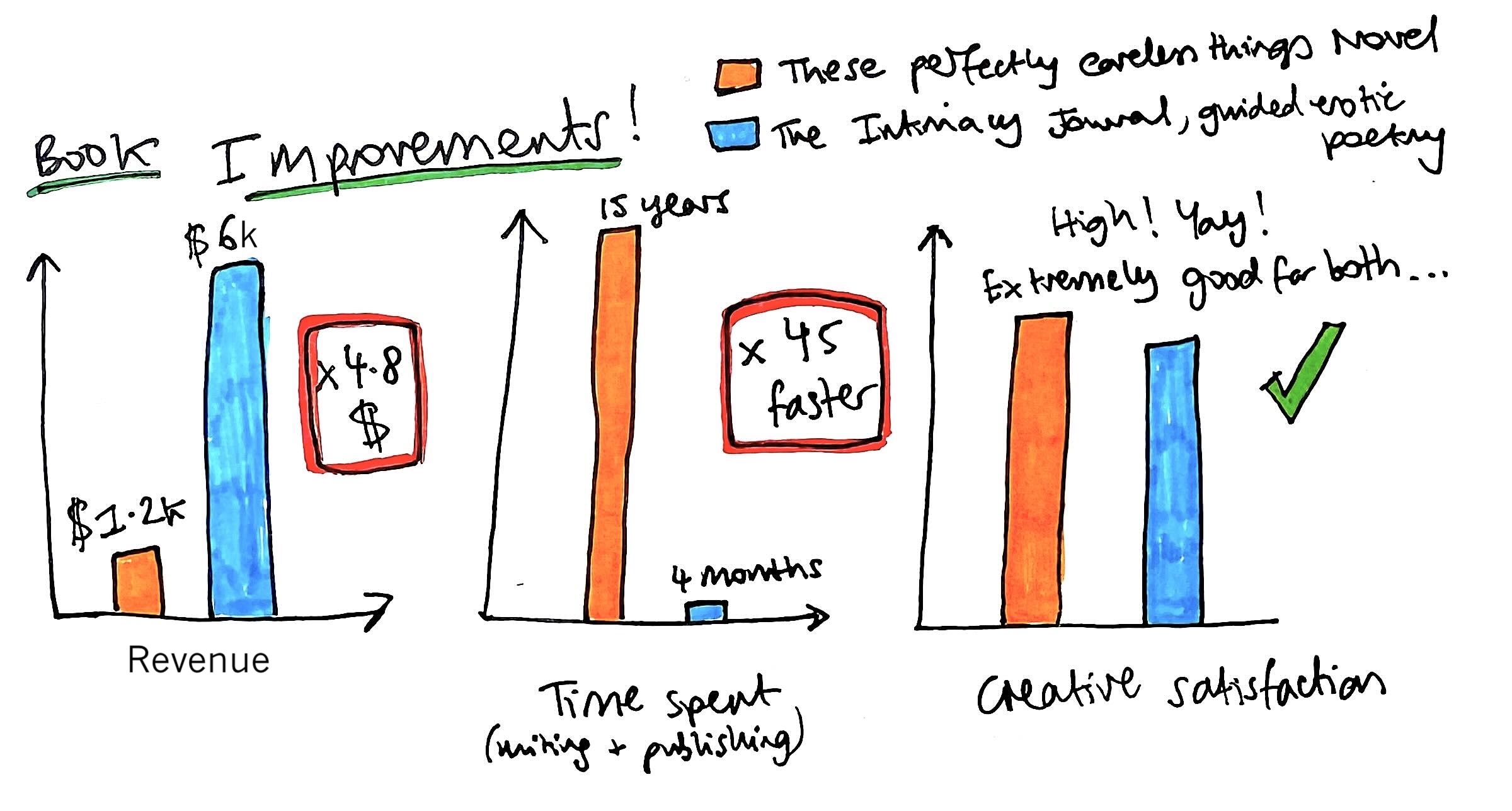
The lesson is you should consider doing a Kickstarter for your next indie book launch or project. It gives you options to bundle and upsell people on higher tiers, which makes a difference. FYI, the bump in revenue from These Perfectly Careless Things in May 2024 came from hosting my book launch in New York.

Money Summary: Publishing a novel

Requirements: Writing and editing a story of around 80,000 words for up to 15 years

Revenue Potential: Low

Effort Needed: Extremely High

Creative Satisfaction: Extremely High

Stress Level: Depends on the season

Tash’s notes: Sometimes you have to do things that don’t make financial sense to follow your childhood dreams and fulfill your creative destiny. Facebook groups like 20Books to 50k, can gamify the novel-writing process, because the more you churn novels out, the faster you make money. I have another novel in the works, but for now, having one published is enough for me.

Money Summary: Publishing a journal + Launching it on Kickstarter

Requirements: Selecting poems, learning a new publishing software, finding a printer (extremely hard, will discuss another time), and completing a month-long Kickstarter Campaign.

Revenue Potential: Medium + Growing

Effort Needed: High

Creative Satisfaction: Extremely High

Stress Level: Medium

Tash’s notes: I absolutely loved every minute of making The Intimacy Journal; it was amazing. I miss creating it, honestly, and I’m excited for what the future holds!

Key Learnings

1. Marketing matters!

“I came to believe that each of us has two jobs: the job we do, and the job of marketing ourselves to make as much money as possible while doing it.” — Amanda Holden, “How to Be a Rich Old Lady.”

This is my favorite quote about making money ever. And if anything, I regret not following this advice sooner. All my numbers here would be much bigger if I consistently promoted my own work, but I definitely haven’t done enough. It’s something I’m working on, and it’s a process. I’ve just restarted using Atoms, James Clear’s app, where I share my work or pitch something once a day. That shit compounds. Trust me!

2. Always be selling.

I’m still selling about $100 of Intimacy Journals every month because I literally carry copies with me almost everywhere I go (read more here, point 3). I’ve now sold 49 copies this way.
3. “How did you hear about me?”

This simple question is one of the easiest and most effective ways to understand what of your marketing work is actually converting into sales. I prompt people with this question at checkout on my online shop, and these are their answers:

N/A: 3 copies sold (This was before I set up the question. Do you see how useless and hard it is to know where these people came from? Yikes!)

Honeydew Me Podcast: 9 copies sold

Jessa Zimmerman Better Sex Podcast: 1 copy sold

Online friends of Tash: 2 copies sold

Misseducated Newsletter Reader: 1 copy sold

Which brings me to my next point…

4. Have a (good) podcast strategy

After speaking on podcasts for a few years, the return on my time investment has been brutal. Of course, maybe I needed to speak on 100 not-so-great podcasts to practice my public speaking skills. But the only episode that’s really translated into book sales for me is the one I did with Honeydew Me. I recently re-listened to it, and noticed what was working for me:

a) I actually read two chapters of The Intimacy Journal aloud on the podcast, with poems and prompts. The hosts loved it. Book immersion works, people! Help the listeners get a taste of what’s inside.

b) The podcast had a large enough audience of intention-aligned people. Honeydew Me is a sex-positive show for Gen Z girls figuring it out, encouraging vulnerable conversations. That’s my exact target market. Nuff said.

5. Intangible learnings + Long-Term Assets > Revenue

Creating “Audiobooks” (0% of Revenue) for both of my books also required a decent investment. Recording costs $60 an hour in Panoram Studios in Mexico City. My novel took me about 15 hours to record, plus about 100 hours of editing, and I have sold 10 audiobooks. The Intimacy Journal took me 3 hours to record, and I haven’t sold any standalone audiobooks, though I upsold it as part of a bundle to my Kickstarter backers.

That’s a lot of money and time, and I’m obviously in the red. But the experience of recording in a world-class music studio was really cool! I felt like a legit author and movie star. I also got to practice reading aloud a lot, which is an invaluable skill that will help me with many aspects of my career, including my workshops.

Plus, who’s to say I won’t make money on these assets in the future? I own all the rights, so who knows?

6. Keep going until you reach the next unlock.

For “In-Person Workshops” (4% of Revenue), did you know I made that $583 in one day? It was for the workshop I did at Soho House in Mexico City in January 2026. It’s my highest single-day earnings since I started this whole thing (aside from my lump-sum Kickstarter payment after the campaign). Plus, I sold a couple of books that day. It was awesome.

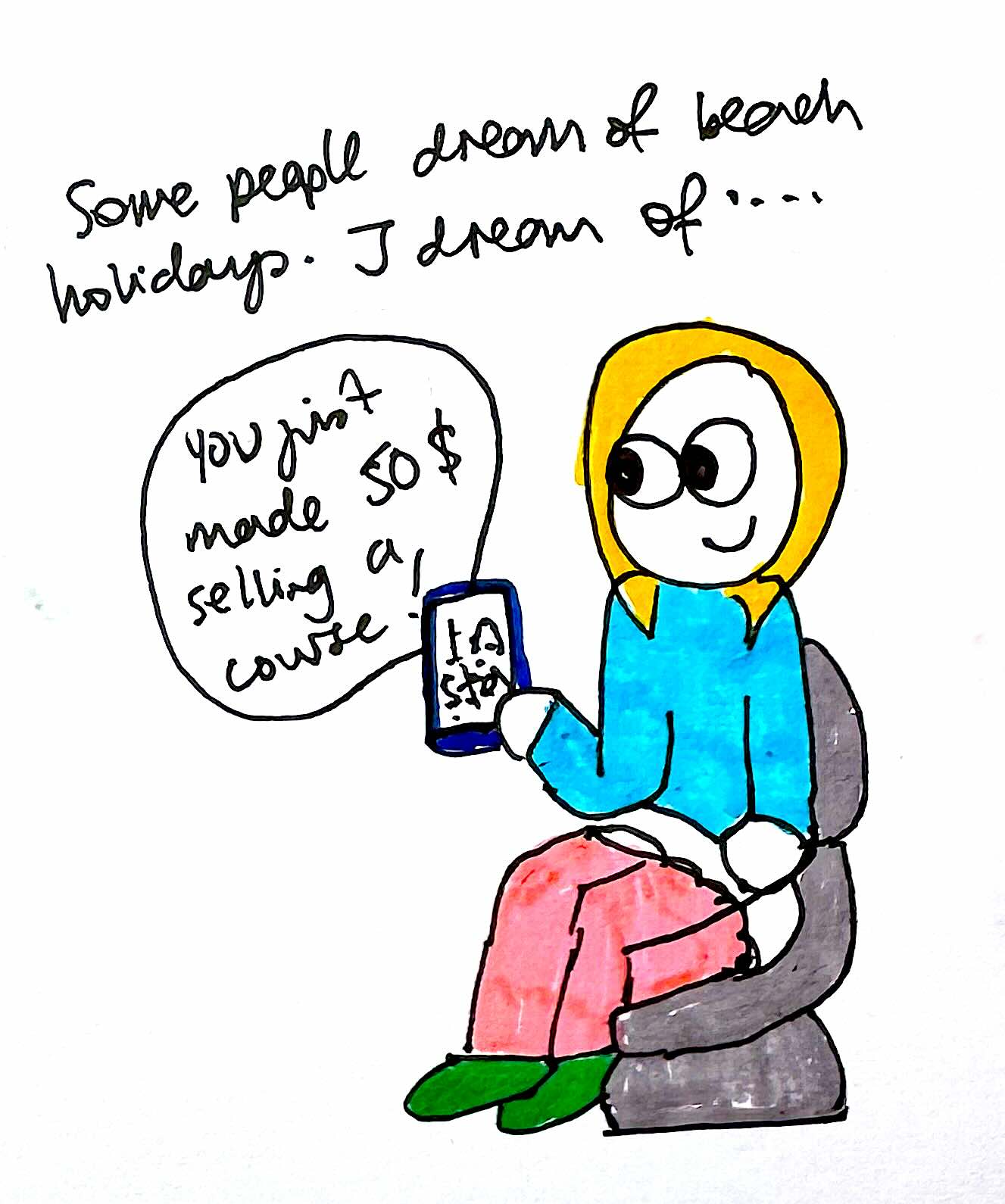
Clearly, my revenue is not scaling linearly. Yes, it took me 3 and a half years to get that opportunity. But now that I’m a 2x published author with actual material to teach, this new avenue has opened up. I’m also turning my intimacy workshops into online writing courses that people can buy while I’m scrolling on Instagram in the bathroom. Even if The Intimacy Journal itself isn’t fully paying the bills yet, the project as a whole is leading me into greener pastures.
7. Conserve your energy

I could do more “Online Workshops” (4% of Revenue), but I’ve found that it’s a metric shit ton of work. You have to organize an online calendar event, create a flyer, invite people, and advertise multiple times. You can only really charge like $15-$30 per ticket (maybe I’m not charging enough). And then you have to host the damn thing. That’s why I liked doing an in-person workshop organized by someone else: they bring the audience, I bring my books and intimacy writing curriculum, and voila.

With any creative career, there are a lot of things you could do or be doing. Try to tune into how each activity affects your energy, leaving you energized or drained. Then see if there is a more chill (and ideally more lucrative) way to get where you’re trying to go.

8. Celebrate all your tiny wins

One thing that’s helped me handle the ups and downs is keeping a “Progress List” of all the teeny, tiny things I’ve accomplished. Everything from querying my first agent to my first rejection to the first time my article on the best porn categories for women hit 100 clicks in a day! Lol.

When you do win something, whether that’s an inbound email from a potential collab or a happy customer sending you a note, please take a minute to savor it. I’m still bad at this. Even last weekend, I submitted a guest pitch to Lenny’s Podcast, one of the biggest tech bros on the internet, with a cool idea about female founders. I sent it off, and then I kept grinding.

Instead, when you accomplish something cool, please actually stop. Take a moment to savor that, give yourself a pat on the back or a glass of champagne, and be proud of what you’ve just done.

Conclusion

Do I regret writing my novel on and off for 15 years, only to end up in the red? Hell no! Of course, I’d love to hit the NY Times bestseller lists and be rich and famous right off the bat. But in the years since I published it, I’ve realized that project mattered to me on a human-soul-spirit-connection level. I had always dreamed of writing and publishing my first novel. And that was the story that came out of me. I may still have 40 copies of it sitting in my closet, but like all the other assets I’ve created, from my audiobooks to my articles, I have a funny feeling their value and the revenue from them will only compound with time.

The last thing I’ll say is that, right now, I’ve just made it through the hardest quarter of my life so far, financially and otherwise. If you’re a creative of any kind, you have to extend the time horizon. I joke that I am only 4 years into my 10-year plan. In the 10-year plan, there is room to fuck up again and again, as you’ve seen me do here. As the great poem, “Maximus, to himself”, goes, “we are all late / in a slow time, / that we grow up many / And the single / is not easily known”.

Thank you for reading! I hope you found this helpful. If you aren’t in the loop already, subscribe to Misseducated to get 3 shamelessly sexy tips in your inbox each week, and hopefully a little extra motivation as you build your own wild, beautiful and wonderful creative career. Good luck!
If you enjoyed this article, subscribe to read more of my work and follow my journey...

How I Make Money As A Creative

“I have had to learn the simplest things / last. Which made for difficulties.” — Charles Olson, “Maximus, to himself

Introduction

I’m Tash Doherty, and welcome to the honest financial breakdown of how I made $15k USD from creative income over the last 4 years. Whether you’re a long-time lurker on my blog or a first-time creative trying to figure out your way, I hope my successes and failures shared here help guide you in your next steps building your own career, or help you gain a useful framework or two.

I quit my miserable corporate job in New York in March 2022, and since then, I’ve been building Misseducated, a Substack blog and podcast where I’m on a mission to help the world be shamelessly sexy. I’m up to almost 800 subscribers, and I’ve published two books: These Perfectly Careless Things, a novel, and The Intimacy Journal, a guided erotic poetry journal,  from which I teach intimacy writing workshops. I help people use the power of writing to explore their sexuality. My creative assets have made me this much money so far:

My revenue totals just over $15k USD, and it’s trending in the right direction 📈, but reality is a bitch. I’m in the messy middle of building this new life, and it’s not enough for me to live on in a meaningful way, as the rest of my income comes from consulting projects and my savings. Still, I’ve recently stumbled across some new, bigger-ticket opportunities, which I’ll get into, and I hope to make more money this year than last. But I’m not holding my breath! Here’s that $15k broken down by the products or services I’ve sold:

Now, let’s crunch some data and get the full scoop of what’s going on here 😎🤘.

The Deep Dive

Reader Subscriptions (Paid Substack Subscribers) - 42% of Revenue

You might look at the table above and think: that’s amazing! Just blast people on Substack and milk every dollar out of your paid Substack subscribers as possible! Well, not so fast. Those numbers on a yearly basis tell quite a different story.

Or if you prefer to see numbers visualized, here’s my ARR in one big, fat frown, lol ☹️.

Launching my first paid subscription on my Substack in November 2022 was a huge deal at the time! I remember meeting up with my new friend Jacqueline on the rooftop at Haab in Condesa, Mexico City. She was the first person who agreed to pay for my creative work. Wow!

However, keeping paid subscriptions going has been extremely challenging. It forced me as a writer to produce double the work: regular content for my free subs and special content for my paid subs, every week or every month. Over the years, this has caused me an insane amount of stress. I’ve constantly struggled with whether I’m doing enough for my paid people, and I don’t want them to hate me.

Another tradeoff I didn’t foresee was that I kept my more x-rated content behind the paywall (you know, like the articles where I admit to liking butt stuff), which was really annoying because only the few people who paid could access my best stuff. After years of internal struggle, in November 2025, I just said: fuck it. I’ll ungate all my content, forego the short-term revenue, and just focus on growing my audience as a whole.

In the short run, this worked. My gross annualized revenue declined by 29.8%, but my total subscriber count has increased by 34%. Now the novelty of that has worn off a bit, and growth has stalled, but that’s okay. I’m a lot less stressed than I used to be, and I’ll survive it.

FYI, if you’re a writer, notice that I still have paid subscriptions turned on. I just explicitly told my subscribers that this is now a “buy-me-a-coffee” model, and while a bunch of people dropped off, those that still pay adds up to just over $1,000 per year. The point is, your family and friends do want to support you, so consider turning on paid subscriptions so they can.

Money Summary: Reader Subscriptions (Paid Substack Subscribers)

Requirements: Writing weekly or monthly paywalled content, in addition to regular content

Revenue Potential: High, but only if you can keep it up

Effort Needed: High, all the fucking time

Creative Satisfaction: Medium

Stress Level: Extremely High

Tash’s notes: Paywalled content is bad for growth in the early stages, but consider turning paid subscriptions on with a “buy-me-a-coffee” model.

Kickstarter Campaign (23% of Revenue) & Book Sales (18% of Revenue)

I launched a Kickstarter Campaign for my second book, The Intimacy Journal, at the end of 2025. It did pretty well, and we were fully funded in 12 days. I found setting myself a challenge to complete a creative project in a limited time very effective; I wanted people to be able to buy The Intimacy Journal as a Christmas gift, so I started grinding on July 1st and got it done. Deadlines work, people! Or at least they work for me when there’s a project I want to do.

I’ve made more money from my “Kickstarter Campaign” ($3.5k) than from all my other “Book Sales” combined ($2.7k), which tells you a sad, hard fact about the book business. For all the time I have spent writing my books, the return so far has been extremely poor, but money isn’t everything (see Key Learnings below). Still, I’ve improved significantly between the books, around 4.8x!

I learned a lot from publishing the novel ($10 for digital, $16 for paperback, an automated process but shitty margins on Amazon), and applied it to the journal ($15 for digital, $29 for paperback, gift-quality product only available on my website).

I’ve sold around 200 copies of These Perfectly Careless Things, a novel which I wrote on and off for 15 years, and I’m deep in the red on my novel when you add in the $1,000 I spent on the copy editor only (not including the book identification numbers (ISBNs), the hours, the developmental editor, the software for formatting my book, the print-on-demand orders).

Meanwhile, I’ve sold 250 copies of The Intimacy Journal, which took me 4 months end-to-end to publish, so about 2% (1/45th) of the time my novel took. Plus, The Intimacy Journal comes with additional revenue streams: this $6k figure also includes hosting intimacy writing workshops, 1:1 creative sessions, and the extra copies I’ve sold. It’s crazy to see the line differences over time:

The lesson is you should consider doing a Kickstarter for your next indie book launch or project. It gives you options to bundle and upsell people on higher tiers, which makes a difference. FYI, the bump in revenue from These Perfectly Careless Things in May 2024 came from hosting my book launch in New York.

Money Summary: Publishing a novel

Requirements: Writing and editing a story of around 80,000 words for up to 15 years

Revenue Potential: Low

Effort Needed: Extremely High

Creative Satisfaction: Extremely High

Stress Level: Depends on the season

Tash’s notes: Sometimes you have to do things that don’t make financial sense to follow your childhood dreams and fulfill your creative destiny. Facebook groups like 20Books to 50k, can gamify the novel-writing process, because the more you churn novels out, the faster you make money. I have another novel in the works, but for now, having one published is enough for me.

Money Summary: Publishing a journal + Launching it on Kickstarter

Requirements: Selecting poems, learning a new publishing software, finding a printer (extremely hard, will discuss another time), and completing a month-long Kickstarter Campaign.

Revenue Potential: Medium + Growing

Effort Needed: High

Creative Satisfaction: Extremely High

Stress Level: Medium

Tash’s notes: I absolutely loved every minute of making The Intimacy Journal; it was amazing. I miss creating it, honestly, and I’m excited for what the future holds!

Key Learnings

1. Marketing matters!

“I came to believe that each of us has two jobs: the job we do, and the job of marketing ourselves to make as much money as possible while doing it.” — Amanda Holden, “How to Be a Rich Old Lady.”

This is my favorite quote about making money ever. And if anything, I regret not following this advice sooner. All my numbers here would be much bigger if I consistently promoted my own work, but I definitely haven’t done enough. It’s something I’m working on, and it’s a process. I’ve just restarted using Atoms, James Clear’s app, where I share my work or pitch something once a day. That shit compounds. Trust me!

2. Always be selling.

I’m still selling about $100 of Intimacy Journals every month because I literally carry copies with me almost everywhere I go (read more here, point 3). I’ve now sold 49 copies this way.

3. “How did you hear about me?”

This simple question is one of the easiest and most effective ways to understand what of your marketing work is actually converting into sales. I prompt people with this question at checkout on my online shop, and these are their answers:

N/A: 3 copies sold (This was before I set up the question. Do you see how useless and hard it is to know where these people came from? Yikes!)

Honeydew Me Podcast: 9 copies sold

Jessa Zimmerman Better Sex Podcast: 1 copy sold

Online friends of Tash: 2 copies sold

Misseducated Newsletter Reader: 1 copy sold

Which brings me to my next point…

4. Have a (good) podcast strategy

After speaking on podcasts for a few years, the return on my time investment has been brutal. Of course, maybe I needed to speak on 100 not-so-great podcasts to practice my public speaking skills. But the only episode that’s really translated into book sales for me is the one I did with Honeydew Me. I recently re-listened to it, and noticed what was working for me:

a) I actually read two chapters of The Intimacy Journal aloud on the podcast, with poems and prompts. The hosts loved it. Book immersion works, people! Help the listeners get a taste of what’s inside.

b) The podcast had a large enough audience of intention-aligned people. Honeydew Me is a sex-positive show for Gen Z girls figuring it out, encouraging vulnerable conversations. That’s my exact target market. Nuff said.

5. Intangible learnings + Long-Term Assets > Revenue

Creating “Audiobooks” (0% of Revenue) for both of my books also required a decent investment. Recording costs $60 an hour in Panoram Studios in Mexico City. My novel took me about 15 hours to record, plus about 100 hours of editing, and I have sold 10 audiobooks. The Intimacy Journal took me 3 hours to record, and I haven’t sold any standalone audiobooks, though I upsold it as part of a bundle to my Kickstarter backers.

That’s a lot of money and time, and I’m obviously in the red. But the experience of recording in a world-class music studio was really cool! I felt like a legit author and movie star. I also got to practice reading aloud a lot, which is an invaluable skill that will help me with many aspects of my career, including my workshops.

Plus, who’s to say I won’t make money on these assets in the future? I own all the rights, so who knows?

6. Keep going until you reach the next unlock.

For “In-Person Workshops” (4% of Revenue), did you know I made that $583 in one day? It was for the workshop I did at Soho House in Mexico City in January 2026. It’s my highest single-day earnings since I started this whole thing (aside from my lump-sum Kickstarter payment after the campaign). Plus, I sold a couple of books that day. It was awesome.

Clearly, my revenue is not scaling linearly. Yes, it took me 3 and a half years to get that opportunity. But now that I’m a 2x published author with actual material to teach, this new avenue has opened up. I’m also turning my intimacy workshops into online writing courses that people can buy while I’m scrolling on Instagram in the bathroom. Even if The Intimacy Journal itself isn’t fully paying the bills yet, the project as a whole is leading me into greener pastures.

7. Conserve your energy

I could do more “Online Workshops” (4% of Revenue), but I’ve found that it’s a metric shit ton of work. You have to organize an online calendar event, create a flyer, invite people, and advertise multiple times. You can only really charge like $15-$30 per ticket (maybe I’m not charging enough). And then you have to host the damn thing. That’s why I liked doing an in-person workshop organized by someone else: they bring the audience, I bring my books and intimacy writing curriculum, and voila.

With any creative career, there are a lot of things you could do or be doing. Try to tune into how each activity affects your energy, leaving you energized or drained. Then see if there is a more chill (and ideally more lucrative) way to get where you’re trying to go.

8. Celebrate all your tiny wins

One thing that’s helped me handle the ups and downs is keeping a “Progress List” of all the teeny, tiny things I’ve accomplished. Everything from querying my first agent to my first rejection to the first time my article on the best porn categories for women hit 100 clicks in a day! Lol.

When you do win something, whether that’s an inbound email from a potential collab or a happy customer sending you a note, please take a minute to savor it. I’m still bad at this. Even last weekend, I submitted a guest pitch to Lenny’s Podcast, one of the biggest tech bros on the internet, with a cool idea about female founders. I sent it off, and then I kept grinding.

Instead, when you accomplish something cool, please actually stop. Take a moment to savor that, give yourself a pat on the back or a glass of champagne, and be proud of what you’ve just done.

Conclusion

Do I regret writing my novel on and off for 15 years, only to end up in the red? Hell no! Of course, I’d love to hit the NY Times bestseller lists and be rich and famous right off the bat. But in the years since I published it, I’ve realized that project mattered to me on a human-soul-spirit-connection level. I had always dreamed of writing and publishing my first novel. And that was the story that came out of me. I may still have 40 copies of it sitting in my closet, but like all the other assets I’ve created, from my audiobooks to my articles, I have a funny feeling their value and the revenue from them will only compound with time.

The last thing I’ll say is that, right now, I’ve just made it through the hardest quarter of my life so far, financially and otherwise. If you’re a creative of any kind, you have to extend the time horizon. I joke that I am only 4 years into my 10-year plan. In the 10-year plan, there is room to fuck up again and again, as you’ve seen me do here. As the great poem, “Maximus, to himself”, goes, “we are all late / in a slow time, / that we grow up many / And the single / is not easily known”.

Thank you for reading! I hope you found this helpful. If you aren’t in the loop already, subscribe to Misseducated to get 3 shamelessly sexy tips in your inbox each week, and hopefully a little extra motivation as you build your own wild, beautiful and wonderful creative career. Good luck!

If you enjoyed this article, subscribe to read more of my work!

Latest POSTS