
My Creative Manifesto

A sassy perspective on how to live a truly creative life.

My Creative Manifesto
Shamblen Studio

Introduction

You’ve caught me in the messy middle. I’ve self-published two books, and my creative vision is still coming to fruition. I’m currently broke, yet when it comes to building a creative life, this is what I have faith in. This is what I believe.

I grew up in London, in an environment where nothing really mattered except being academically gifted in serious subjects like science and business, and making lots of money. I believed that in order to make that money, you had to dedicate your life to something you hated. The more you hated your life, the more money you’d probably make.

This has never been my approach to life. In my mind, I’ve never separated work, life, and pleasure. Despite evil corporate forces and societal expectations, I’ve found and dedicated myself to things I deeply care about. Not because I believe that I’m special (though I’m sure ego has something to do with it). But more because, for better or worse, I’ve been guided by feelings. For example, I’m enjoying writing for you right now. Let me do more of it. I like this piece of art, the design of this thing, or the look of that architecture. It’s pretty. It’s nice. Pure, basic aesthetics are what drive me.

In this manifesto, I push through the frankly toxic beliefs of my childhood and move into a world of feelings, self-expression, and pretty things, while also making a living. To do this, I’ve brought together data, philosophies of new role models, and “alternative facts” (lol). This is not a dream. This is not a rehearsal dinner for the wedding of life. I’ve reconstructed a way to live that centers joy as something to be taken seriously, where you can make money, and potentially lots of it, doing something you absolutely love. I’ve written this for you because I believe that how we see the world changes what we believe is possible for us. Let’s begin.

1. Make stuff.

The words I hate to hear most out of someone’s mouth are: “I’ve always wanted to…but…” Come on, people! It’s the 21st century, and climate change is about to burn us all to a crisp. Do not tell me about your ideas and dreams you have no intention of pursuing. Do not be like that woman in her 60s, whom I met at a sushi dinner party, who always dreamt of becoming a sitcom screenwriter. Wtf is wrong with you? Sit down right now and write the first word. There is nothing stopping you.

Dreams are not real, just a fantasy that will die with you. You actually have to start somewhere and make stuff. I don’t care if you write really slowly. I don’t care if what you start creating is literal crap. Just make something. Start with one brush stroke or write one word on the page, and make it real. Then you’ll have something to work with. The only exception is if you are a mother with young children under 5. Everyone else, no excuses.

As Anne Lamott said: “[A] lot of my workshops involve people explaining to me that they’re going to start writing as soon as their last child is out of the house, as soon as they move to the Russian River, as soon as they retire…if you’re not writing now, you’re not gonna write then…The key is not to try harder, but to resist less.”

2. Replace your idols

Despite the core philosophy of depressed money-making in my childhood, there was one quirky side character whom I’ve tried to bring to the center stage.

Sir Paul Smith is a legendary British menswear fashion designer. I grew up a privileged little tot, and at one point in 2012, I found out that he lived on my street, in a large house on the corner covered with purple wisteria. It was a very dark, empty, and mysterious place because I later learned that Paul leaves at 5am every day to go swimming, and I imagine his wife, Pauline, does too. I was on the committee of a lecture society at my fancy school, and so I wrote Sir Paul Smith a handwritten letter inviting him to speak. I got an email from one of his assistants not long after, and he accepted the invitation! She later told me that Paul had never really used a computer, so a handwritten note was really the only way to get his attention.

The day Sir Paul Smith came to speak at my school, I introduced him to a crowd of 400 curious teenagers. One thing that stood out from his talk was that he showed a picture of a row of beach houses he saw in the UK, and then a new suit and pair of socks with their color palette translated straight onto them. He also threw keychains across the room to students who asked questions in the Q&A. It was awesome, and we later toured his studio in Covent Garden.

Sir Paul Smith made an impression on me. To this day, I regularly think of his words at the beginning of his interview on the Blamo! Podcast,

“And I thought: I wonder if you can go earn a living doing something that’s creative like this. It could be a brilliant way of earning a living. And it just progressed from there.”

I keep a little chromic blue dog on my desk. It’s a miniature of one that I couldn’t afford to buy at Paul Smith’s shop in Notting Hill. But it reminds me that making money isn’t all grind and pain. It can be fun, and even inspired by a colorful row of beach houses.

3. Fuck the gatekeepers.

“While the artist’s goal is greatness, it’s also to move forward. In service of the next project, we finish the current one. In service of the current project, we finish it so it can be set free into the world.” — Rick Rubin, The Creative Act.

Putting a piece of creative work out into the world is a vulnerable thing to do. If we don’t have a ton of creative experience, it’s natural to want validation from some industry leader or accomplished person. We may anxiously proofread our email to them 100 times before we send it. What if they say no, or worse, don’t respond at all? Who will we be then?

Rejection of your work from a gatekeeper might feel like the end of your world, but I’d argue that it’s just the beginning. It doesn’t matter if it’s one gatekeeper or 10; it means nothing. So what if Sarah, the New York literary agent you really wanted, probably hungover in the Hamptons, emailed you to say “Thank you for the chance to read your work, but it’s not a fit.” You spent fifteen years writing that novel (in my case) and put real effort into making something awesome. Fuck it!

A piece of work you put a lot of effort into is probably good, and your effort alone is enough of a reason for it to see the light of day. It deserves to arrive in its final state of completion: birthed, published, shown, seen, witnessed. You need to finish this piece so that you can start making something else. I spent years and years writing my debut novel, queried a metric shit ton of literary agents, and got all rejections. My inner teenager needed that book to be published, but I wanted to work on other things. I decided to self-publish it. Even if it wasn’t perfect. Even if I never quite got the marketing right for that book. But I did it. Here I am, free on the other side, to make more work. I haven’t sat around for another 3 years waiting for a traditional publishing deal and fantasizing about becoming an author, because I already am one.

Of course, I would have loved to have a big publishing deal, lots of money, and millions of copies sold. Maybe if I had been patient for six more months and then waited another two years for the book to be published, I’d be as rich and famous as Sally Rooney or Dolly Alderton. But also, more likely, I wouldn’t be. I might have gotten discouraged and traipsed back to New York to my horrible corporate life again with my tail between my legs.

Most creative careers are built through teeny, tiny actions to no fanfare or clapping audience. Maybe a few people will clap for you, and a few people will email you to say how much they loved your work. But ultimately, waiting for acceptance can be a far greater risk than experiencing the rejection itself.

p.s. There is one way gatekeepers can be useful to you. I’ve noticed that when I write something to pitch to The New York Times or McSweeney's, I produce better writing. If you’re pitching a publication, you’re probably not going to send them something crap, so they’re useful as a phantom, 3rd-party accountability buddy that can challenge you to raise the bar for your work. Yet, when they inevitably reject it, put your work out there anyway! The previously rejected pieces that I published myself are among my most successful and widely shared. My readers love it. My creative cup is filled. And I take one more step to building a body of impactful work that I’m proud of.

4. Don’t let anyone tell you who you are.

I met a girl last summer who absolutely enraged me. As we chatted, I learned she was an impressive,  traditionally published author of two books. Her first book was, in publishing terms, a “flop” because the release date coincided with the beginning of COVID. She wrote another book, and that one did a bit better, but she had fallen out of favor with her publishing gods, and both of her books would soon be out of print.

“Can’t you release the paperbacks somehow?” I said, reeling. “There’s got to be something you can do about this.”

“Nah,” she said, shrugging. “They own all the rights. I pitched them another book idea, but they wanted me to write something else. I’d basically have to start writing again from scratch.”

I mean, yes, you would, I thought to myself. But isn’t that the point? It’s your writing, your name, your life’s work! But for her, clearly it wasn’t. The publishing gods had decided which of her stories were going to exist, and according to them, her whole writing career was “over.”

I fundamentally disagree with this. Don’t let anyone decide your career is over for you. Take action. Raise your voice, and don’t give a fuck what anyone else thinks. I put my work out there myself because I want to: my workshops, my courses, my books, my thoughts, my articles. The power is mine.

5. Fight for your rights.

“When I was really young, William Burroughs told me…“Keep your name clean. Don’t make compromises. Don’t worry about making a bunch of money or being successful. Be concerned with doing good work, and make the right choices to protect your work. And if you build a good name, eventually that name will be its own currency.” — Patti Smith, Advice to the Young.

I recently went down a rabbit hole on Tetra Pak, the technology used to make cartons, including a 1L carton of milk I pulled out of my fridge here in Mexico City. In 1944, Erik Wallenberg, a 28-year-old assistant at the Åkerlund & Rausing lab, came up with the idea of constructing a tetrahedron-shaped package from a paper tube to more easily transport and store milk (Wikipedia). The company had been investing in R&D and testing packaging for years by the time Wallenberg had the idea. The company’s executives patented the technology within a month and subsequently built it into a multi-billion-dollar empire, printing money to this day. Wallenberg himself made basically no money from his invention. He was only awarded the Grand Gold Medal by the Royal Swedish Academy of Engineering Sciences in 1991, when he was about 76 years old. He got a medal of recognition, but a couple million dollars would have been nice, I’m sure.

If you’re working for a corporation, I’d encourage you to review your employment contract and make sure you retain the rights to all your inventions. It’s a small thing, but these corporations are making lots more money off us these days, so you deserve to get paid for the things you bring into this world. Or at least, you should own shares in the corporation you work for, so you can capture even a tiny bit of the upside. At the end of the day, the institutions you’re a part of have their own agenda, and companies can steal and profit from your ideas, as well as hire and fire you at will.

In the creative world, it’s even worse and more important. You have to fight for your rights. Even the world’s greatest poets, like Maya Angelou or Joy Harjo, gave up their rights to reprint their own work, or so I discovered when I tried and failed to include their poems in The Intimacy Journal. Build your own moat. Never hand over the keys to your castle. This is something you have to constantly prune and reassess as you keep building your creative life.

This is not an easy path. Going independent is obviously the financially worse decision in the short term. A traditional publishing deal will give you an advance and distribution, but as an independent author, I own 100% of a tiny pie. The tradeoff is time and control. I get to build at my own pace, in my own direction. The compounding is slower, but it’s all mine. I’m betting on myself, and I have faith in the universe that this is all going somewhere. Who knows what revenue channels I’ll have built in 5 years’ time, with my own little portfolio of translations and IP.

In practical terms, this looks like migrating my top-performing articles off of my Substack and onto my website, because why am I giving a corporate entity thousands of clicks from articles that I wrote? If I want to publish The Intimacy Journal in Spanish (which I hope to do in the next year), you can damn well bet I’m going to do it. And if I am writing for a publication, I negotiate and sign contracts where my rights to my own work revert to me if they kill the article (see screenshot).
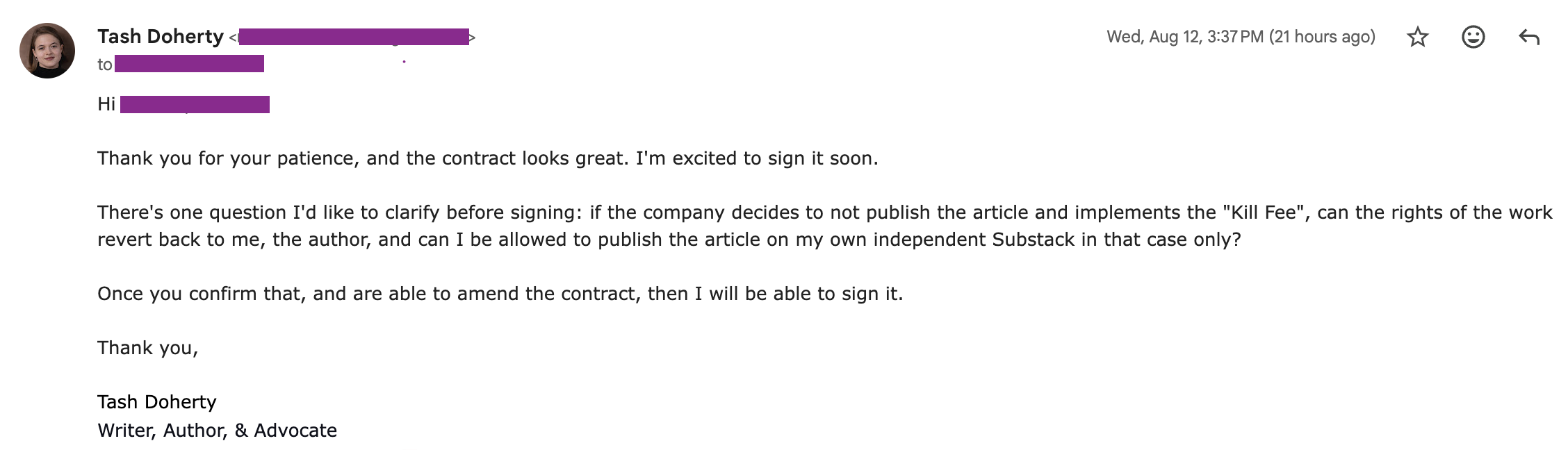
Behold, a writer negotiating rights to her own work! :)

6. Focus on the 10-year plan.

“Anything worthwhile takes a long time.” — Debbie Millman, The Power of Storytelling.

When you’re in the messy middle of days, months, or even years at the beginning of a creative career, it can be easy to beat yourself up as to where you “should” be at any given point in time, even when you don’t really know where you are.

I recently wrote a long article about this called “How I Make Money As A Creative.” I really should have titled it, “How I DON’T Make Money As A Creative,” because $15k in 4 years is, in my opinion, a pretty embarrassingly small amount of revenue to write home about. Sure, I could sit around and mope about how terrible I’ve been at making money in my creative career so far. Or I could take those learnings and build a better workshop, tweak my article format again, and test new social media offerings.

This path is long and winding, and one way to stay the course is to take the pressure off and focus on the 10-year plan. In this expanded time horizon, there is room for weeks where you screw up and don’t sell a book, and you accidentally turn the font on your website white so no one can read your work (this is something that legit happened to me, lol). Forgive yourself, because there is room for all this and more in the 10-year plan. When you give yourself a decade, sometimes you have to take a job for a year or two to pay the bills and fund your life so you can keep going in the right direction.

And time isn’t wasted along the way. Not at all! My experience was summed up so eloquently in an Instagram reel by a girl called Kate, who is walking from Scotland to Hong Kong. She said,

“It’s not like you have to put in 5 years of hell before you can get what you want. If you’re working towards a life you really like, you will also enjoy those 5 years.”

7. Keep your creative process pure.

“Take your pleasure seriously.” — Charles Eames.

Last summer, during the rainy season in Mexico City, I created The Intimacy Journal. As I listened to my favorite creative song on repeat, “murmures” by Jean Michel Blais, I fell into a giant sinkhole of creative bliss that lasted for weeks. I loved the design process of that book. The poetry, the typography, the little emblems, and the drop caps. It was magical. I was often moved to tears just reading a section of the poems I chose.

The energy you put into a creative work translates into the outcome. Your mood. Your feelings. It’s all there, getting alchemized. It’s no coincidence that I’ve written some of my best work while sitting calmly in a forest; the words just flowed right out of me. The vibe and the environment you bring to the work matter.

I was inspired to write this manifesto after reading the letter that Steve Albini, the sound engineer, wrote to the band Nirvana in 1992. In his letter, Albini talks about the band “[banging] a record out in a couple of days, with high quality but minimal 'production' and no interference from the front office bulletheads.” He said he’d love to work with Nirvana, but only if they kept the record company people out of the creative process. Albini wrote,

“I have worked on hundreds of records…and I have seen a direct correlation between the quality of the end result and the mood of the band throughout the process. If the record takes a long time, and everyone gets bummed and scrutinizes every step, then the recordings bear literal resemblance to the live band, and the end result is seldom flattering. Making punk records is definitely a case where more “work” does not imply a better end result.”

So, trust your own creative process. Keep it pure. Keep it fun, whimsical, and energetically effervescent. Follow your joy. Follow your bliss. And be seriously careful about who you let interfere or stick a finger in what you are trying to make. Keep the front office bulletheads out of it.

8. Creative fulfillment is invaluable.

I recently had dinner with a group of Wharton alumni in Mexico City. I sat next to the head of LATAM of a large international conglomerate. This guy was almost the same age as me, except that when he walked into the room, his job title was whispered around him, and people immediately respected him. When he asked me about what I did, I told him about The Intimacy Journal. Then he said to me, multiple times over the course of that night,

“That’s so cool! It’s so impressive you quit corporate to do something different.”

I told him that it’s not all sunshine and roses; I’ve had to borrow money from a family member, and I’m struggling to pay rent, but he couldn’t seem to hear me. He seemed far more hooked on my bold life decisions, finding deep creative fulfillment, and living life with no regrets. I had to agree with him on that.

I don’t want to die tomorrow, of course. But if something tragic were to happen to me, I do think I’m a bit less fussed about dying. With my books and articles, I came. I did. I done it. And there’s something extremely beautiful about that. Now interviewing for jobs, I can take this creative fulfillment back into my corporate work, and trade in a couple of hours with the man because I’ve scratched quite a few of my creative itches. From my resume, you can tell that I’m far from the perfect corporate cupcake. But there’s no denying it: I’ve produced some of the creative work I was born to do, and that’s something you can’t put a salary or a price tag on.

Conclusion

Before I quit my corporate job in New York City, I was stuck on the fence for a very long time. What eventually got me over the edge was doing a macro-dose of magic mushrooms, lol. But when I look back at my former corporate self now, I have nothing but compassion for her. Yes, she could have quit earlier. If I’d kept writing in college, I might have published my novel sooner, and maybe I’d be further down the creative road now. But most of all, I’ve come to believe that the most important thing about living a creative life is not to live in the world of hypotheticals, fantasies, and dreams just out of reach. Instead, we have to ground ourselves in the practical, the next baby step, the execution. We have to do the work. Put it out there. Then do it again.

As Patti Smith said,

“What matters is to know what you want and pursue it. And understand that it’s going to be hard. Because life is really difficult…There’s beautiful things in life. So when you’re suffering, it’s part of the package…Just ride with it.”

If you enjoyed this article, subscribe to read more of my work and follow my journey...

My Creative Manifesto

Introduction

You’ve caught me in the messy middle. I’ve self-published two books, and my creative vision is still coming to fruition. I’m currently broke, yet when it comes to building a creative life, this is what I have faith in. This is what I believe.

I grew up in London, in an environment where nothing really mattered except being academically gifted in serious subjects like science and business, and making lots of money. I believed that in order to make that money, you had to dedicate your life to something you hated. The more you hated your life, the more money you’d probably make.

This has never been my approach to life. In my mind, I’ve never separated work, life, and pleasure. Despite evil corporate forces and societal expectations, I’ve found and dedicated myself to things I deeply care about. Not because I believe that I’m special (though I’m sure ego has something to do with it). But more because, for better or worse, I’ve been guided by feelings. For example, I’m enjoying writing for you right now. Let me do more of it. I like this piece of art, the design of this thing, or the look of that architecture. It’s pretty. It’s nice. Pure, basic aesthetics are what drive me.

In this manifesto, I push through the frankly toxic beliefs of my childhood and move into a world of feelings, self-expression, and pretty things, while also making a living. To do this, I’ve brought together data, philosophies of new role models, and “alternative facts” (lol). This is not a dream. This is not a rehearsal dinner for the wedding of life. I’ve reconstructed a way to live that centers joy as something to be taken seriously, where you can make money, and potentially lots of it, doing something you absolutely love. I’ve written this for you because I believe that how we see the world changes what we believe is possible for us. Let’s begin.

1. Make stuff.

The words I hate to hear most out of someone’s mouth are: “I’ve always wanted to…but…” Come on, people! It’s the 21st century, and climate change is about to burn us all to a crisp. Do not tell me about your ideas and dreams you have no intention of pursuing. Do not be like that woman in her 60s, whom I met at a sushi dinner party, who always dreamt of becoming a sitcom screenwriter. Wtf is wrong with you? Sit down right now and write the first word. There is nothing stopping you.

Dreams are not real, just a fantasy that will die with you. You actually have to start somewhere and make stuff. I don’t care if you write really slowly. I don’t care if what you start creating is literal crap. Just make something. Start with one brush stroke or write one word on the page, and make it real. Then you’ll have something to work with. The only exception is if you are a mother with young children under 5. Everyone else, no excuses.

As Anne Lamott said: “[A] lot of my workshops involve people explaining to me that they’re going to start writing as soon as their last child is out of the house, as soon as they move to the Russian River, as soon as they retire…if you’re not writing now, you’re not gonna write then…The key is not to try harder, but to resist less.”

2. Replace your idols

Despite the core philosophy of depressed money-making in my childhood, there was one quirky side character whom I’ve tried to bring to the center stage.

Sir Paul Smith is a legendary British menswear fashion designer. I grew up a privileged little tot, and at one point in 2012, I found out that he lived on my street, in a large house on the corner covered with purple wisteria. It was a very dark, empty, and mysterious place because I later learned that Paul leaves at 5am every day to go swimming, and I imagine his wife, Pauline, does too. I was on the committee of a lecture society at my fancy school, and so I wrote Sir Paul Smith a handwritten letter inviting him to speak. I got an email from one of his assistants not long after, and he accepted the invitation! She later told me that Paul had never really used a computer, so a handwritten note was really the only way to get his attention.

The day Sir Paul Smith came to speak at my school, I introduced him to a crowd of 400 curious teenagers. One thing that stood out from his talk was that he showed a picture of a row of beach houses he saw in the UK, and then a new suit and pair of socks with their color palette translated straight onto them. He also threw keychains across the room to students who asked questions in the Q&A. It was awesome, and we later toured his studio in Covent Garden.

Sir Paul Smith made an impression on me. To this day, I regularly think of his words at the beginning of his interview on the Blamo! Podcast,

“And I thought: I wonder if you can go earn a living doing something that’s creative like this. It could be a brilliant way of earning a living. And it just progressed from there.”

I keep a little chromic blue dog on my desk. It’s a miniature of one that I couldn’t afford to buy at Paul Smith’s shop in Notting Hill. But it reminds me that making money isn’t all grind and pain. It can be fun, and even inspired by a colorful row of beach houses.

3. Fuck the gatekeepers.

“While the artist’s goal is greatness, it’s also to move forward. In service of the next project, we finish the current one. In service of the current project, we finish it so it can be set free into the world.” — Rick Rubin, The Creative Act.

Putting a piece of creative work out into the world is a vulnerable thing to do. If we don’t have a ton of creative experience, it’s natural to want validation from some industry leader or accomplished person. We may anxiously proofread our email to them 100 times before we send it. What if they say no, or worse, don’t respond at all? Who will we be then?

Rejection of your work from a gatekeeper might feel like the end of your world, but I’d argue that it’s just the beginning. It doesn’t matter if it’s one gatekeeper or 10; it means nothing. So what if Sarah, the New York literary agent you really wanted, probably hungover in the Hamptons, emailed you to say “Thank you for the chance to read your work, but it’s not a fit.” You spent fifteen years writing that novel (in my case) and put real effort into making something awesome. Fuck it!

A piece of work you put a lot of effort into is probably good, and your effort alone is enough of a reason for it to see the light of day. It deserves to arrive in its final state of completion: birthed, published, shown, seen, witnessed. You need to finish this piece so that you can start making something else. I spent years and years writing my debut novel, queried a metric shit ton of literary agents, and got all rejections. My inner teenager needed that book to be published, but I wanted to work on other things. I decided to self-publish it. Even if it wasn’t perfect. Even if I never quite got the marketing right for that book. But I did it. Here I am, free on the other side, to make more work. I haven’t sat around for another 3 years waiting for a traditional publishing deal and fantasizing about becoming an author, because I already am one.

Of course, I would have loved to have a big publishing deal, lots of money, and millions of copies sold. Maybe if I had been patient for six more months and then waited another two years for the book to be published, I’d be as rich and famous as Sally Rooney or Dolly Alderton. But also, more likely, I wouldn’t be. I might have gotten discouraged and traipsed back to New York to my horrible corporate life again with my tail between my legs.

Most creative careers are built through teeny, tiny actions to no fanfare or clapping audience. Maybe a few people will clap for you, and a few people will email you to say how much they loved your work. But ultimately, waiting for acceptance can be a far greater risk than experiencing the rejection itself.

p.s. There is one way gatekeepers can be useful to you. I’ve noticed that when I write something to pitch to The New York Times or McSweeney's, I produce better writing. If you’re pitching a publication, you’re probably not going to send them something crap, so they’re useful as a phantom, 3rd-party accountability buddy that can challenge you to raise the bar for your work. Yet, when they inevitably reject it, put your work out there anyway! The previously rejected pieces that I published myself are among my most successful and widely shared. My readers love it. My creative cup is filled. And I take one more step to building a body of impactful work that I’m proud of.

4. Don’t let anyone tell you who you are.

I met a girl last summer who absolutely enraged me. As we chatted, I learned she was an impressive,  traditionally published author of two books. Her first book was, in publishing terms, a “flop” because the release date coincided with the beginning of COVID. She wrote another book, and that one did a bit better, but she had fallen out of favor with her publishing gods, and both of her books would soon be out of print.

“Can’t you release the paperbacks somehow?” I said, reeling. “There’s got to be something you can do about this.”

“Nah,” she said, shrugging. “They own all the rights. I pitched them another book idea, but they wanted me to write something else. I’d basically have to start writing again from scratch.”

I mean, yes, you would, I thought to myself. But isn’t that the point? It’s your writing, your name, your life’s work! But for her, clearly it wasn’t. The publishing gods had decided which of her stories were going to exist, and according to them, her whole writing career was “over.”

I fundamentally disagree with this. Don’t let anyone decide your career is over for you. Take action. Raise your voice, and don’t give a fuck what anyone else thinks. I put my work out there myself because I want to: my workshops, my courses, my books, my thoughts, my articles. The power is mine.

5. Fight for your rights.

“When I was really young, William Burroughs told me…“Keep your name clean. Don’t make compromises. Don’t worry about making a bunch of money or being successful. Be concerned with doing good work, and make the right choices to protect your work. And if you build a good name, eventually that name will be its own currency.” — Patti Smith, Advice to the Young.

I recently went down a rabbit hole on Tetra Pak, the technology used to make cartons, including a 1L carton of milk I pulled out of my fridge here in Mexico City. In 1944, Erik Wallenberg, a 28-year-old assistant at the Åkerlund & Rausing lab, came up with the idea of constructing a tetrahedron-shaped package from a paper tube to more easily transport and store milk (Wikipedia). The company had been investing in R&D and testing packaging for years by the time Wallenberg had the idea. The company’s executives patented the technology within a month and subsequently built it into a multi-billion-dollar empire, printing money to this day. Wallenberg himself made basically no money from his invention. He was only awarded the Grand Gold Medal by the Royal Swedish Academy of Engineering Sciences in 1991, when he was about 76 years old. He got a medal of recognition, but a couple million dollars would have been nice, I’m sure.

If you’re working for a corporation, I’d encourage you to review your employment contract and make sure you retain the rights to all your inventions. It’s a small thing, but these corporations are making lots more money off us these days, so you deserve to get paid for the things you bring into this world. Or at least, you should own shares in the corporation you work for, so you can capture even a tiny bit of the upside. At the end of the day, the institutions you’re a part of have their own agenda, and companies can steal and profit from your ideas, as well as hire and fire you at will.

In the creative world, it’s even worse and more important. You have to fight for your rights. Even the world’s greatest poets, like Maya Angelou or Joy Harjo, gave up their rights to reprint their own work, or so I discovered when I tried and failed to include their poems in The Intimacy Journal. Build your own moat. Never hand over the keys to your castle. This is something you have to constantly prune and reassess as you keep building your creative life.

This is not an easy path. Going independent is obviously the financially worse decision in the short term. A traditional publishing deal will give you an advance and distribution, but as an independent author, I own 100% of a tiny pie. The tradeoff is time and control. I get to build at my own pace, in my own direction. The compounding is slower, but it’s all mine. I’m betting on myself, and I have faith in the universe that this is all going somewhere. Who knows what revenue channels I’ll have built in 5 years’ time, with my own little portfolio of translations and IP.

In practical terms, this looks like migrating my top-performing articles off of my Substack and onto my website, because why am I giving a corporate entity thousands of clicks from articles that I wrote? If I want to publish The Intimacy Journal in Spanish (which I hope to do in the next year), you can damn well bet I’m going to do it. And if I am writing for a publication, I negotiate and sign contracts where my rights to my own work revert to me if they kill the article (see screenshot).

Behold, a writer negotiating rights to her own work! :)

6. Focus on the 10-year plan.

“Anything worthwhile takes a long time.” — Debbie Millman, The Power of Storytelling.

When you’re in the messy middle of days, months, or even years at the beginning of a creative career, it can be easy to beat yourself up as to where you “should” be at any given point in time, even when you don’t really know where you are.

I recently wrote a long article about this called “How I Make Money As A Creative.” I really should have titled it, “How I DON’T Make Money As A Creative,” because $15k in 4 years is, in my opinion, a pretty embarrassingly small amount of revenue to write home about. Sure, I could sit around and mope about how terrible I’ve been at making money in my creative career so far. Or I could take those learnings and build a better workshop, tweak my article format again, and test new social media offerings.

This path is long and winding, and one way to stay the course is to take the pressure off and focus on the 10-year plan. In this expanded time horizon, there is room for weeks where you screw up and don’t sell a book, and you accidentally turn the font on your website white so no one can read your work (this is something that legit happened to me, lol). Forgive yourself, because there is room for all this and more in the 10-year plan. When you give yourself a decade, sometimes you have to take a job for a year or two to pay the bills and fund your life so you can keep going in the right direction.

And time isn’t wasted along the way. Not at all! My experience was summed up so eloquently in an Instagram reel by a girl called Kate, who is walking from Scotland to Hong Kong. She said,

“It’s not like you have to put in 5 years of hell before you can get what you want. If you’re working towards a life you really like, you will also enjoy those 5 years.”

7. Keep your creative process pure.

“Take your pleasure seriously.” — Charles Eames.

Last summer, during the rainy season in Mexico City, I created The Intimacy Journal. As I listened to my favorite creative song on repeat, “murmures” by Jean Michel Blais, I fell into a giant sinkhole of creative bliss that lasted for weeks. I loved the design process of that book. The poetry, the typography, the little emblems, and the drop caps. It was magical. I was often moved to tears just reading a section of the poems I chose.

The energy you put into a creative work translates into the outcome. Your mood. Your feelings. It’s all there, getting alchemized. It’s no coincidence that I’ve written some of my best work while sitting calmly in a forest; the words just flowed right out of me. The vibe and the environment you bring to the work matter.

I was inspired to write this manifesto after reading the letter that Steve Albini, the sound engineer, wrote to the band Nirvana in 1992. In his letter, Albini talks about the band “[banging] a record out in a couple of days, with high quality but minimal 'production' and no interference from the front office bulletheads.” He said he’d love to work with Nirvana, but only if they kept the record company people out of the creative process. Albini wrote,

“I have worked on hundreds of records…and I have seen a direct correlation between the quality of the end result and the mood of the band throughout the process. If the record takes a long time, and everyone gets bummed and scrutinizes every step, then the recordings bear literal resemblance to the live band, and the end result is seldom flattering. Making punk records is definitely a case where more “work” does not imply a better end result.”

So, trust your own creative process. Keep it pure. Keep it fun, whimsical, and energetically effervescent. Follow your joy. Follow your bliss. And be seriously careful about who you let interfere or stick a finger in what you are trying to make. Keep the front office bulletheads out of it.

8. Creative fulfillment is invaluable.

I recently had dinner with a group of Wharton alumni in Mexico City. I sat next to the head of LATAM of a large international conglomerate. This guy was almost the same age as me, except that when he walked into the room, his job title was whispered around him, and people immediately respected him. When he asked me about what I did, I told him about The Intimacy Journal. Then he said to me, multiple times over the course of that night,

“That’s so cool! It’s so impressive you quit corporate to do something different.”

I told him that it’s not all sunshine and roses; I’ve had to borrow money from a family member, and I’m struggling to pay rent, but he couldn’t seem to hear me. He seemed far more hooked on my bold life decisions, finding deep creative fulfillment, and living life with no regrets. I had to agree with him on that.

I don’t want to die tomorrow, of course. But if something tragic were to happen to me, I do think I’m a bit less fussed about dying. With my books and articles, I came. I did. I done it. And there’s something extremely beautiful about that. Now interviewing for jobs, I can take this creative fulfillment back into my corporate work, and trade in a couple of hours with the man because I’ve scratched quite a few of my creative itches. From my resume, you can tell that I’m far from the perfect corporate cupcake. But there’s no denying it: I’ve produced some of the creative work I was born to do, and that’s something you can’t put a salary or a price tag on.

Conclusion

Before I quit my corporate job in New York City, I was stuck on the fence for a very long time. What eventually got me over the edge was doing a macro-dose of magic mushrooms, lol. But when I look back at my former corporate self now, I have nothing but compassion for her. Yes, she could have quit earlier. If I’d kept writing in college, I might have published my novel sooner, and maybe I’d be further down the creative road now. But most of all, I’ve come to believe that the most important thing about living a creative life is not to live in the world of hypotheticals, fantasies, and dreams just out of reach. Instead, we have to ground ourselves in the practical, the next baby step, the execution. We have to do the work. Put it out there. Then do it again.

As Patti Smith said,

“What matters is to know what you want and pursue it. And understand that it’s going to be hard. Because life is really difficult…There’s beautiful things in life. So when you’re suffering, it’s part of the package…Just ride with it.”

If you enjoyed this article, subscribe to read more of my work!

Latest POSTS